


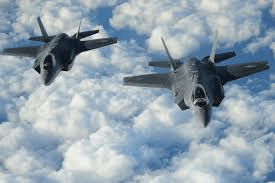
Now the strategic balance in West Asia is undergoing a massive recalibration. In response to the ongoing conflict with Iran and lessons from Operation Roaring Lion, Israel has officially approved a multi-billion dollar defense deal to acquire additional F-35I and F-15IA fighter jets from the United States. Therefore, the Israeli Air Force (IAF) is positioning itself for a decade of air dominance by pairing stealth penetration with heavy-strike capacity. Meanwhile, fresh shipments of 6,500 tonnes of US military equipment have already arrived at Israeli ports to bolster immediate readiness.
Add businessleague.in as a Preferred Source


Also Read |Tamil Nadu Voter List Purge: 97 Lakh Names Deleted in SIR Phase 1
Operation Roaring Lion: The Catalyst for Airpower Expansion
Now the backdrop for this massive procurement is a state of active regional conflict. Operation Roaring Lion, a joint US-Israeli military campaign launched on February 28, 2026, has fundamentally changed Israel’s defense priorities. Therefore, the IAF is looking to consolidate the air superiority it established during the largest military flyover in its history.
First, the operation targeted Iranian missile systems and strategic infrastructure. Next, senior defense officials noted that the intensity of the confrontation accelerated the procurement timeline. Thus, the new jets are not just for future “what-if” scenarios, but are a direct response to current battlefield dynamics.
So the lessons from the 2026 hostilities have highlighted the need for persistent air presence. Meanwhile, the IDF has emphasized that strategic cooperation with the US is at an all-time high. Therefore, the new squadrons represent a “reset” for Middle Eastern warfare in the 2030s.
F-35I Adir: Israel’s Unique Stealth ‘First-Strike’ Platform
Now the F-35I “Adir” remains the crown jewel of Israel’s stealth penetration strategy. Unlike other international partners, Israel is uniquely permitted to integrate its own indigenous mission systems and electronic warfare suites. Therefore, the Adir is a platform tailored specifically for the contested airspace of West Asia.
First, the stealth profile allows the IAF to penetrate deep into enemy territory without detection. Next, its advanced sensor fusion provides real-time targeting data to the entire digital combat network. Thus, it serves as the “door opener” for any complex aerial operation.
So the expansion to 100 F-35I aircraft effectively doubles Israel’s stealth capacity. Meanwhile, recent reports suggest the Adir has already logged over 15,000 flight hours across multiple fronts from Iran to Yemen. Therefore, the Adir is now a battle-hardened asset in the IAF’s arsenal.
F-15IA: The Heavy Hitter Designed for Sustained Strike Campaigns
Now if the F-35I opens the door, the F-15IA walks through it. Derived from Boeing’s F-15EX Eagle II, the “IA” variant is optimized for payload and endurance rather than stealth. Therefore, it is the platform of choice for massed strikes against hardened strategic targets.
First, the F-15IA can carry a significantly larger quantity of precision-guided munitions compared to stealth fighters. Next, it features upgraded AESA radar and a modern digital backbone for better target tracking. Thus, it provides the “mass” required for sustained, long-range campaigns.
So the second squadron of F-15IAs will consolidate Israel’s ability to project power over extended ranges without forward basing. Meanwhile, its open-architecture design allows for the seamless integration of Israeli-made weapons. Therefore, the F-15IA ensures that the IAF can execute high-volume operations long after enemy air defenses have been suppressed.
Also Read |Tamil Nadu Voter List Purge: 97 Lakh Names Deleted in SIR Phase 1
Doctrinal Shift: Pairing Stealth Penetration with Massed Firepower
Now the IAF is implementing what experts call a “layered air dominance” doctrine. The goal is to create a complementary operational architecture where stealth and heavy payload work in tandem. Therefore, the procurement of both platforms simultaneously is a deliberate strategic choice.
The Operational Logic:
-
F-35I Role: Initial penetration, suppression of enemy air defenses (SEAD), and “decapitation” strikes.
-
F-15IA Role: High-volume follow-on strikes, sustained campaign endurance, and long-range payload delivery.
First, this dual-platform strategy reduces reliance on external logistical support during protracted conflicts. Next, it allows for simultaneous operations across multiple fronts. Thus, Israel is scaling its capabilities from surgical strikes to full-spectrum air warfare.
Timeline and Logistics: When Will the New Squadrons Arrive?
Now the absorption of these advanced squadrons is a multi-year project. While immediate wartime needs are being met by US airlifts, the long-term fleet growth follows a staggered schedule. Therefore, the IAF is balancing current readiness with future modernization.
First, Israel already operates 48 F-35I jets, with the final two of the initial 50-jet order expected in 2026. Next, deliveries for the third F-35 squadron (ordered in 2023) are expected to begin in 2028. Thus, the newly approved fourth squadron will likely enter service in the early 2030s.
So the F-15IA timeline is similarly structured. Meanwhile, the first 25 aircraft ordered in 2024 are expected to arrive starting in 2031. Therefore, the “technological leap” described by the Ministry of Defense will be a phased transition over the coming decade.
US Support: The 6,500-Tonne Military Shipment Explained
Now while the fighter jets represent the future, immediate support is arriving via maritime corridors. On April 30, 2026, two cargo ships carrying 6,500 tonnes of military aid were offloaded at the ports of Ashdod and Haifa. Therefore, the US-Israel strategic relationship remains the cornerstone of regional stability.
First, the shipment included thousands of air and ground munitions, as well as military trucks and Joint Light Tactical Vehicles (JLTVs). Next, this is part of a central effort that has seen over 115,000 pieces of equipment arrive via 403 airlifts since February. Thus, the logistical bridge between Washington and Tel Aviv is operating at peak capacity.
So these munitions are critical for replenishing stockpiles during the ongoing confrontation with Iran. Meanwhile, the arrival of JLTVs strengthens ground-based readiness. Therefore, the US is providing both the “sword” (fighter jets) and the “shield” (munitions and logistics) for Israel.
Also Read |Tamil Nadu Voter List Purge: 97 Lakh Names Deleted in SIR Phase 1
Maintaining the Edge: Autonomous Flight and Next-Gen Systems
Now the Ministry of Defense is looking beyond traditional piloting. The force-building plan includes a shift toward autonomous flight capabilities and next-generation defense systems. Therefore, the IAF is preparing for a “space-integrated” future.
First, the new aircraft will feature AI-driven mission software to assist pilots in high-intensity environments. Next, there is a focus on self-protection systems to counter advanced integrated air defense systems (IADS). Thus, the IAF aims to maintain “military superiority, defensive and offensive, in space” and in the air.
So the 80 million shekel upgrade for the aging F-16 fleet is also part of this effort. Meanwhile, the total budget of 350 billion shekel underscores the scale of this ambition. Therefore, Israel is not just buying platforms; it is building a full-spectrum capability for the next generation of warfare.
FAQ: Israel’s 2026 Fighter Jet Procurement
1. Which fighter jets is Israel buying in the new deal? Now, Israel has approved a fourth squadron of F-35I “Adir” jets and a second squadron of F-15IA aircraft.
2. What is ‘Operation Roaring Lion’? First, it is a joint US-Israeli military campaign against Iran launched in February 2026. Next, it serves as the primary catalyst for the current defense upgrade.
3. How many F-35I jets will Israel have in total? So once all deliveries are complete, the IAF expects to field a fleet of approximately 100 F-35I aircraft.
4. What makes the F-15IA different from the F-35I? Next, the F-35I is a stealth-focused penetration fighter. Thus, the F-15IA is a heavy-strike platform designed for high payload and long-range missions.
5. When will the new jets be delivered? Now, deliveries are staggered. The third F-35 squadron begins in 2028, while the first F-15IAs are expected by 2031.
6. What was in the recent 6,500-tonne US shipment? Finally, it included thousands of air/ground munitions, military trucks, and Joint Light Tactical Vehicles (JLTVs) to bolster immediate readiness.
Also Read |Tamil Nadu Voter List Purge: 97 Lakh Names Deleted in SIR Phase 1
End…
Add businessleague.in as a Preferred Source

