


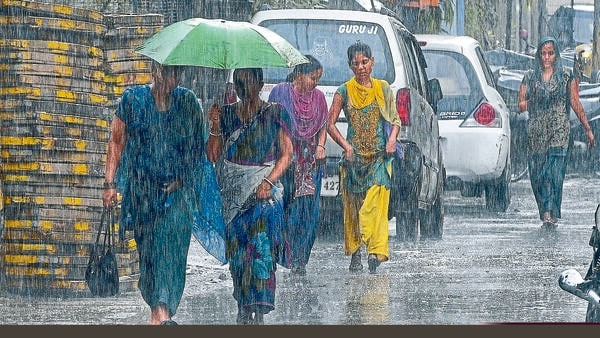
As blistering 43°C pre-monsoon heat collides with sea-borne moisture, atmospheric lift triggers towering storm cells—offering quick respite but demanding safety precautions.
NEW DELHI — The suffocating, high-humidity heatwave that has held the National Capital Region (NCR) hostage reached a boiling point on Sunday evening, forcing an explosive atmospheric correction. With regional observatories logging a maximum temperature of 41.3°C and a punishing heat index or “feels-like” temperature crossing 48.4°C, the local airmass finally ruptured. The India Meteorological Department (IMD) rapidly escalated its short-range weather warnings, placing major sectors of Delhi and its satellite cities under an orange alert.
Add businessleague.in as a Preferred Source


Also Read | EPFO to Enable UPI & ATM Withdrawals: Financial Experts Warn of Risks
The urgent district-level nowcast warned of moderate thunderstorms heavily packaged with frequent lightning strikes and intense, straight-line gusty winds traveling between 41 to 61 kilometers per hour.
Decoding the Color-Coded Warning Levels
For everyday residents navigating the NCR commute, understanding the exact severity of the weather agency’s alert matrices is essential for personal safety:
IMD Weather Warning Matrix:
├── Green Alert
│   └── Significance: Clear Skies. No advisory actions or operational warnings required.
├── Yellow Alert
│   └── Significance: Watchful Status. Stay updated on shifting local configurations.
├── Orange Alert (Current Status)
│   └── Significance: Be Prepared. Moderate-to-severe storms with potential infrastructure damage.
└── Red Alert
    └── Significance: Take Direct Action. High-consequence severe event unfolding immediately.
An orange alert is not an invitation to panic. Rather, it serves as an official administrative nudge for citizens to clear loose objects from high-rise balconies, seek structural indoor shelter, and halt non-essential transit until the primary gust front clears the micro-region.
Also Read | EPFO to Enable UPI & ATM Withdrawals: Financial Experts Warn of Risks
The Atmospheric Formula Driving the Gale
The dramatic late-June storm is a classic example of a transitional weather event. The region is currently stuck in a tense tug-of-war between lingering pre-monsoon heat and the early vanguard of the southwest monsoon.
[43°C Ground Bake] + [Moist Sea Winds] + [Western Disturbance] = 10km High Cumulonimbus Storm Cells
This sudden violent turbulence relies on three foundational meteorological ingredients:
-
High CAPE (Thermal Fuel): Days of consistent 41°C to 43°C ground temperatures have heavily warmed the immediate surface air. This trapped energy is quantified by meteorologists as Convective Available Potential Energy (CAPE). The higher the CAPE, the faster hot, buoyant air shoots vertically into the upper atmosphere.
-
Dual-Marine Moisture: Low-level easterly winds drifting inland from the Bay of Bengal and southwesterly currents from the Arabian Sea have saturated the Delhi skies with water vapor.
-
The Upper-Level Trigger: A passing western disturbance—a low-pressure moisture band traveling over north India from the Mediterranean—provided the final physical shove required to lift this unstable air.
The result is the rapid creation of massive cumulonimbus clouds. These towering, anvil-topped storm systems can breach heights of more than 10 kilometers, functioning as massive high-energy thermal engines.
Reading Live Doppler Radar Reflectivity
As animated radar feeds circulate across digital platforms, tracking the precise arrival of a storm cell requires understanding radar reflectivity, measured in decibels of reflectivity (dBZ).
The severe gales accompanying these cells are generated by downdrafts—pockets of dense, rain-cooled air that drop out of the upper cloud layers and crash into the earth, spreading out horizontally as a high-speed gust front. Concurrently, internal friction caused by collisions between ice crystals and soft hail separates electrical charges within the cloud base, creating the pathways needed for cloud-to-ground lightning bolts.
While the storm guarantees a brief, beautiful drop in temperatures over the next 48 hours, residents are strongly urged to avoid standing under unstable billboards, isolate sensitive electrical appliances, and park personal vehicles clear of weak tree canopies.
Also Read | EPFO to Enable UPI & ATM Withdrawals: Financial Experts Warn of Risks
FAQ
What is the safest course of action if I am caught outdoors during an orange alert?
If an intense gust front hits while you are outside, immediately move away from temporary overhead structures, metal signboards, and high-voltage power lines. Do not take shelter under solitary trees, as they act as natural lightning rods. If you are operating a vehicle, pull over safely to the side of the road, activate your hazard lights, and remain inside the metal chassis of your vehicle until the primary lightning activity subsides.
Why do these severe storms build up so rapidly during late afternoon hours?
These storms are heavily dependent on diurnal (daytime) solar heating. The ground acts as a thermal radiator, absorbing heat throughout the morning and early afternoon. By 3:30 PM to 5:00 PM, the ground heat reaches its maximum potential, maximizing the atmosphere’s lift (CAPE) and causing moist air masses to rapidly bubble upward into storm clouds within a matter of hours.
Does this sudden orange alert mean the southwest monsoon has officially arrived in Delhi?
No. This evening storm is classified as an intense pre-monsoon convective storm. While moisture from the advancing monsoon is feeding the cloud systems, the official arrival of the southwest monsoon over Delhi-NCR requires sustained, widespread rainfall patterns and a permanent wind-shift, which regional forecasters expect will consolidate fully around early July.
Also Read | EPFO to Enable UPI & ATM Withdrawals: Financial Experts Warn of Risks
Add businessleague.in as a Preferred Source

