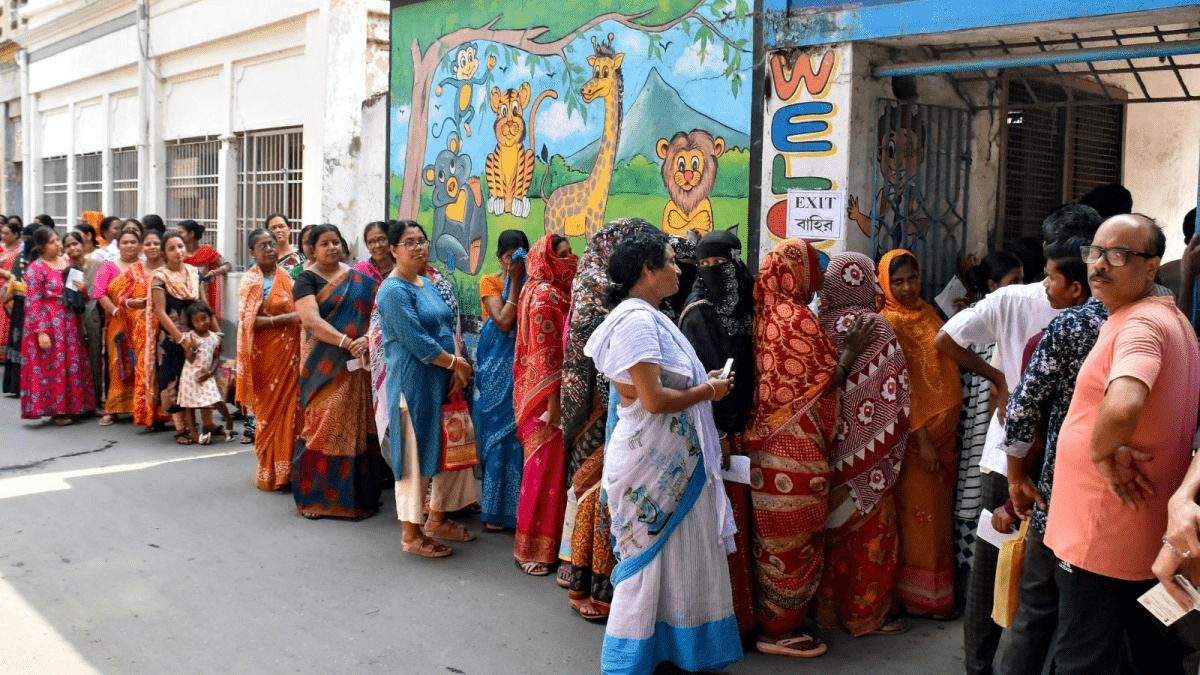
Now the dust has settled on the first phase of the West Bengal assembly elections, the headline figure is staggering: 93. Specifically, a record 92.89 per cent voter turnout has been recorded, marking a massive 10.5 percentage point jump from 2021. Therefore, the Bengal voting figures 2026 record turnout is being hailed as a triumph for the world’s largest democracy. However, beneath the surface of this historic participation lies a complex and controversial “baseline shift” that could redefine the entire electoral outcome.
Add businessleague.in as a Preferred Source


Meanwhile, both the Trinamool Congress (TMC) and the Bharatiya Janata Party (BJP) are rushing to frame this high percentage as a victory for their respective camps.
But for analysts, the real story isn’t the number of people who voted, but the nearly 91 lakh people who were purged from the lists just days before the polls.
Also Read |Tamil Nadu Voter List Purge: 97 Lakh Names Deleted in SIR Phase 1
The SIR Scrubbing: Why 90.8 Lakh Names Vanished
Now the 2026 election will be remembered for the “Special Intensive Revision” (SIR). This Exercise was mandated by the Election Commission to remove deceased, duplicate, and “illegal” voters. Therefore, the Bengal voting figures 2026 record turnout is inextricably linked to this administrative purge.
The Scale of the Purge
First, around 12 per cent of the total electorate was removed just days before the first phase. Then, an estimated 90.8 lakh men and women saw their names struck off the rolls. Thus, the total voter base shrank to approximately 6.75 crore. Next, despite fierce legal challenges from the TMC and civil activists, the Supreme Court backed the exercise as a necessary cleaning of the rolls. Therefore, the entire Phase 1 was conducted on a fundamentally altered electoral map.
Phase 1 Math: Working Out the Real Percentages
Now let’s look at the hard numbers. Post-SIR, the voter base for the 152 seats in Phase 1 was 3.61 crore. Therefore, with 3.35 crore votes cast, the math leads straight to the 92.8% headline.
The Estimates Debate
First, if we factor the 37 lakh “scrubbed” Phase 1 voters back into the equation, the math changes significantly. Then, assuming a pre-SIR electorate of roughly 4 crore, the turnout percentage drops to a level almost identical to 2021. Thus, the “record-breaking” aspect of the Bengal voting figures 2026 record turnout might be an arithmetic byproduct of the smaller denominator. Next, experts suggest the real turnout increase was likely only 1.85 per cent when adjusted for the purge. Therefore, the “wave” narrative might be a statistical illusion created by the scrubbing.
Baseline Shift: How Removing Names Pumps Up Turnout
Now we must understand why a “smaller list” creates a “higher percentage.” When you strike off 10,000 names from a constituency but the same number of people show up to vote, the percentage appears to skyrocket. Therefore, the high turnout doesn’t necessarily signal an anti-incumbency wave.
Reframing the Outcome
First, the baseline for Phase 1 was roughly 37 lakh fewer people than in 2021. Then, this massive shift makes it look like more people are participating, even if the actual number of voters remains steady. Thus, the BJP has hailed this as “Operation Clean-up” bringing transparency. Next, the TMC argues that the shift skews the democratic will by silencing legitimate voters whose appeals are still pending. Therefore, the 92.89% figure is a double-edged sword that provides ammunition to both political camps.
Also Read |Tamil Nadu Voter List Purge: 97 Lakh Names Deleted in SIR Phase 1
Political Impact: Targeted Deletions in TMC Strongholds
Now the political fallout of the SIR is concentrated in specific demographics. The TMC has flagged that the deletions have heavily impacted Muslim communities in Malda, Murshidabad, and the 24 Parganas. Therefore, the Bengal voting figures 2026 record turnout may hide a targeted disenfranchisement of the ruling party’s base.
Districts Under the Knife:
-
Murshidabad: 66% Muslim population; saw significant deletions.
-
Malda: 51% Muslim population; key TMC stronghold affected.
-
South 24 Parganas: Accounted for a major chunk of the 12.2 lakh total deletions in Muslim-majority belts.
First, the TMC won 75 seats across these four districts in 2021—accounting for 35% of their total wins. Then, the list was slashed in over 82% of the seats won by the TMC last time. Thus, the party’s winning margin is under direct threat. Next, some seats won by slim margins, like South Dinajpur, saw significant name removals. Therefore, the “arithmetic intersection” of SIR and voting patterns favors a potential shift in power.
BJP Risks: Impact on the Matua and Border Seats
Now, while the TMC has complained the loudest, the BJP is not immune to the purge. The Matua community, a critical voting bloc for the BJP in 2021, has also seen heavy deletions.
Community Blowback
First, community leaders claim that nearly 70 per cent of their members received deletion notices. Then, border seats like Dinhata, which the BJP won by less than 60 votes in 2021, have seen 10,000 names struck off. Thus, the BJP’s own “victory cushion” has been thinned out in competitive seats. Next, Balarampur and Moyna are similarly poised for a high-risk outcome due to the scrubbing. Therefore, the SIR has likely cost both sides, making the final tally even more unpredictable.
The Tipping Point: Victory Margins and Flipped Seats
Now the ultimate significance of the Bengal voting figures 2026 record turnout lies in the narrow margins. In 2021, 69 seats were decided by less than 5%, and 28 were decided by less than 4,000 votes. Therefore, even a small concentration of deletions can flip a seat.
The Math of Flipping
First, consider a seat with 200,000 voters where a candidate needs 100,001 to win. Then, if the rolls are scrubbed to 180,000, that candidate now needs only 91,001. Thus, the “tipping point” for victory has moved significantly lower. Next, if the deletions were concentrated in the supporter base of one party, the seat is “flipped” before a single new vote is cast. Therefore, the 2026 election is as much a battle of the “voter roll” as it is a battle of the “voter box.”
Also Read |Tamil Nadu Voter List Purge: 97 Lakh Names Deleted in SIR Phase 1
Mamata vs. Amit Shah: The Battle of Narratives
Now the post-voting narrative is being ferociously debated. Home Minister Amit Shah has invoked conventional wisdom—that a high turnout signals a change in government.
Corruption vs. Rights
First, Shah claimed on X that the high turnout means “The sun of Trinamool’s corruption and hooliganism has set.” Then, Mamata Banerjee countered by claiming the people voted to “protect their rights” and reject the BJP’s “purging tactics.” Thus, both leaders are attempting to galvanize their base ahead of Phase 2 on April 29. Next, the debate over “ghuspaithiya” (infiltrators) vs. “legitimate citizens” remains the primary campaign pillar. Therefore, the 92.89% figure is being used as a Rorschach test for political strength.
Expert Take: Is the Election Won Before it Begins?
Now many experts suggest that the SIR math has made the election a “pre-calculated” affair. If the baseline shifts significantly enough, the margins pivot regardless of campaign efforts.
The Arithmetic Tsunami
First, the total number of deletions (90.8 lakh) is actually slightly more than the TMC’s winning margin from 2021. Then, this creates an “arithmetic tsunami” that could wash away the incumbent’s lead. Thus, even a relatively unchanged actual number of votes could result in a different winner due to the smaller denominator. Next, the concentration of these cuts in high-stakes districts like North 24 Parganas is the “variable” that will decide the day. Therefore, the final outcome of the 2026 Bengal election will be the ultimate decoding of these record-breaking figures.
Common Questions Answered
Was the 92.89% Bengal voter turnout real? Now mathematically, yes. However, it was calculated based on a voter list that was 12% smaller due to the SIR purge. Thus, the actual participation jump was likely more modest.
What is the SIR purge? First, it stands for Special Intensive Revision. Then, it was an exercise ordered by the Election Commission to remove nearly 91 lakh illegal, deceased, or duplicate voters.
Who does the voter roll scrubbing help? Next, both sides claim it hurts them. Thus, the TMC flags Muslim community deletions, while the BJP notes that its Matua vote bank was also affected.
How many seats could be flipped by the SIR? So analysts are watching 69 seats that were decided by less than 5% in 2021. Therefore, even small, targeted deletions could pivot these margins.
When is the next phase of the Bengal election? Finally, the second and final phase will be held on April 29, 2026. Thus, the high-turnout narrative will be tested again very soon.
Also Read |Tamil Nadu Voter List Purge: 97 Lakh Names Deleted in SIR Phase 1
End….
Add businessleague.in as a Preferred Source
🙏 Support Independent Journalism
We keep news free for you.
Most readers support with ₹500 ❤️
or scan QR below

Voluntary contribution. No tax benefits.
DISCLAIMER
We have taken all measures to ensure that the information provided in this article and on our social media platform is credible, verified and sourced from other Big media Houses. For any feedback or complaint, reach out to us at businessleaguein@gmail.com