


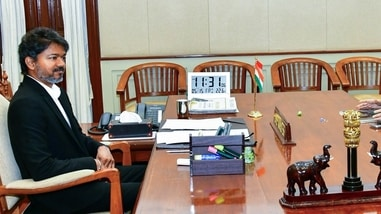
Now a subtle yet historically profound transformation is taking place within the corridors of Fort St. George. The newly elected Chief Minister of Tamil Nadu, Vijay, has quietly shattered a long-standing bureaucratic tradition by removing the customary white cotton towel from his official executive chair. Therefore, this rapid administrative adjustment marks a deliberate departure from legacy protocols that have governed Indian government offices for generations. Meanwhile, the visual shift became clear in official photographs shared by the Chief Minister’s office on Friday, May 15, 2026. Following a viral public appeal by renowned teenage climate activist Licypriya Kangujam, the decision is being widely praised on social media platforms as a progressive statement against deep-rooted VIP culture.
Add businessleague.in as a Preferred Source


Also Read |Tamil Nadu Voter List Purge: 97 Lakh Names Deleted in SIR Phase 1
Caught on Camera: Tracking the Shift Across Consecutive Meetings
Now the fast structural shift inside the Tamil Nadu secretariat was captured perfectly through the lens of official media updates. During a high-level review meeting for the Department of Industries, Investment Promotion, and Commerce held on Thursday, May 14, standard protocols were fully visible. Therefore, photos showed the Chief Minister seated upon an executive chair draped in the traditional white linen cloth.
First, the imagery was completely standard, matching what citizens have expected from heads of state for decades. Next, a stark contrast emerged during Friday’s scheduled diplomatic and business audiences at the CMO. Thus, photographs documenting the CM’s meetings with TAFE Chairperson Mallika Srinivasan and Vice-Chairperson Dr. Lakshmi Venu showed the pristine leather chair completely exposed.
So the complete absence of the white cloth has created an intense buzz across local news networks. Central administrative staff have not issued any formal statements to clarify the modification. Therefore, the visual confirmation from the CMO’s official imagery stands as a definitive confirmation of the protocol shift.
The Activist’s Petition: Licypriya Kangujam’s Crusade Against VIP Norms
Now the catalyst for this immediate transformation was an explicit public appeal broadcast across the internet. Teenage climate advocate Licypriya Kangujam utilized the social platform X to petition the newly elected leader to abandon the old layout. Therefore, her post directly challenged the new administration to set a modern precedent for the state.
First, Kangujam pointed out that using towels for VIP seating is a pervasive practice stretching from top ministers down to low-level bureaucrats. Next, she argued that the continuation of this habit serves no functional purpose other than to reinforce a rigid class structure. Thus, the mechanical necessity of challenging systemic hierarchies was brought directly to the leader’s attention.
So following the visual removal on Friday, the activist returned to social media to express her gratitude. She published side-by-side comparison graphics to celebrate the rapid execution of her request. Therefore, the interaction demonstrates an immediate feedback loop between the young populace and the new executive leadership.
The Colonial Genesis: Why India’s ‘White Towel’ Culture Existed
Now to understand why the white cloth remains so firmly rooted in government buildings, one must examine its colonial origin story. Long before the widespread integration of modern air conditioning systems, offices across the Indian subcontinent faced extreme climatic conditions. Therefore, the hot and humid regional weather forced a reliance on cotton drapes.
The Functional Evolution of the Bureaucratic Towel:
-
Moisture Absorption: Provided a quick, accessible method to wipe away sweat during intense summer heat.
-
Upholstery Preservation: Guarded heavy office drapes and fabric chairs from permanent skin oil stains.
-
Sanitization Standards: Became a visible symbol of cleanliness, discipline, and daily hygiene within hot halls.
First, the heavy cotton towel allowed administrators to perform prolonged desk work without ruining import-grade furniture. Next, over the decades, the practical asset slowly transitioned into a permanent emblem of official status and authority. Thus, even after climate-controlled ventilation systems became standard, the decorative custom survived as a mechanical necessity of bureaucratic rank.
Also Read |Tamil Nadu Voter List Purge: 97 Lakh Names Deleted in SIR Phase 1
Public Reaction: A Viral Movement Against Bureaucratic Hierarchy
Now social media networks have erupted with intense commentary following the circulation of the towel-free photographs. Citizens and political analysts are dissecting the move as far more than a simple aesthetic alteration. Therefore, the choice is being framed as an intentional strike against the traditional “VIP culture” that isolates elected representatives from the masses.
First, online discussions have highlighted that the white cloth often acts as an invisible barrier separating officialdom from everyday petitioners. Next, commentators are contrasting this progressive approach with the rigid habits maintained by long-term political figures in neighboring states. Thus, the visual omission has been elevated into a potent symbol of modern populism.
So the public praise has provided the newly formed cabinet with an immediate wave of popular goodwill. Meanwhile, younger voters have celebrated the change as a sign of administrative transparency and humility. Therefore, the viral nature of the reaction proves how deeply the public values the dismantling of old feudal customs.
A Fast-Paced Week: Contextualizing Vijay’s First Strategic Decrees
Now the removal of the iconic seat drapery is part of a broader, high-velocity agenda marking the Chief Minister’s inaugural week in office. Having assumed his constitutional role on May 10, 2026, the leader has initiated a wave of structural transformations. Therefore, the office is working under extreme pressure to deliver immediate, visible metrics to the electorate.
First, the administration recently finalized a massive directive targeting state-regulated commercial activities. Next, executive orders mandated the absolute closure of over 700 government-operated TASMAC liquor retailers situated near educational institutions and transit hubs. Thus, the “towel decree” aligns cleanly with a broader strategy of swift public-interest interventions.
So the first seven days have established a clear, disruptive baseline for how the new executive team intends to operate. Meanwhile, senior administrative officers are adjusting to a significantly accelerated pace of decision-making. Therefore, the visual shifts at Fort St. George are reflective of a deeper operational overhaul.
The New Coalition: Understanding the Structural Makeup of the TVK Government
Now the legislative authority backing these rapid decrees stems from a fresh political configuration in the state assembly. Vijay’s political launch vehicle, Tamilaga Vettri Kazhagam (TVK), emerged from the recent elections as the single largest legislative unit. Therefore, the party has successfully constructed a collaborative coalition system to ensure stable governance.
-
Core Party: Tamilaga Vettri Kazhagam (TVK).
-
Coalition Partners: The Indian National Congress, IUML, CPI(M), CPI, and the VCK.
First, this multi-party alliance gives the Chief Minister a robust legislative majority to execute major systemic reforms. Next, the diverse composition of the front requires a constant balancing of local and national ideological priorities. Thus, maintaining absolute transparency in daily operations is a mechanical necessity for preserving coalition trust.
Also Read |Tamil Nadu Voter List Purge: 97 Lakh Names Deleted in SIR Phase 1
Dismantling Symbolism: The Broader Movement for Administrative Reform
Now macro-level observers are pointing out that true administrative modernization requires the systematic elimination of outdated colonial artifacts. While a simple cloth may seem inconsequential to outside critics, its presence shapes the daily interactions between citizens and the state. Therefore, its removal is a necessary step toward humanizing the bureaucracy.
First, the gesture encourages lower-tier district collectors and department heads to re-evaluate their own local office layouts. Next, it challenges the deeply internalized idea that government service entitles an official to special material privileges. Thus, the “towel-free” movement could spark a wider modernization drive across the entire state machinery.
So as the TVK administration enters its second week, the focus remains firmly fixed on structural equity. Meanwhile, the public continues to monitor the CMO for further signs of institutional transformation. Therefore, the simple act of uncovering a chair has set a permanent benchmark for democratic accessibility in 2026.
FAQ: Frequently Asked Questions on CM Vijay’s Towel Removal
1. Why did Tamil Nadu Chief Minister Vijay remove the white towel from his chair? Now, the Chief Minister removed the traditional towel following a viral public appeal on social media, aiming to dismantle colonial-era VIP culture and hierarchy within government buildings.
2. Who initiated the viral request to eliminate the towel culture? First, the petition was started by teenage climate activist Licypriya Kangujam, who urged the newly elected Chief Minister to set an egalitarian example for all state departments.
3. What was the original historical purpose of the white towel in Indian offices? So, during the colonial era before air conditioning, white cotton towels were used as a mechanical necessity to absorb sweat, cool officials, and protect heavy furniture fabrics from skin oil stains.
4. When did this visible change take place in the CMO? Next, the visual change was captured by official cameras on Friday, May 15, 2026, during the Chief Minister’s formal meetings with prominent corporate leaders.
5. What political party does Chief Minister Vijay lead? Now, he leads the Tamilaga Vettri Kazhagam (TVK), which currently heads a robust coalition government supported by the Congress, CPI(M), CPI, IUML, and VCK.
6. What other major decisions did the CM make during his first week in office? Finally, alongside removing the bureaucratic towel, the Chief Minister ordered the immediate closure of more than 700 government-run TASMAC liquor shops located near schools and transport stations.
Also Read |Tamil Nadu Voter List Purge: 97 Lakh Names Deleted in SIR Phase 1
End….
Add businessleague.in as a Preferred Source

