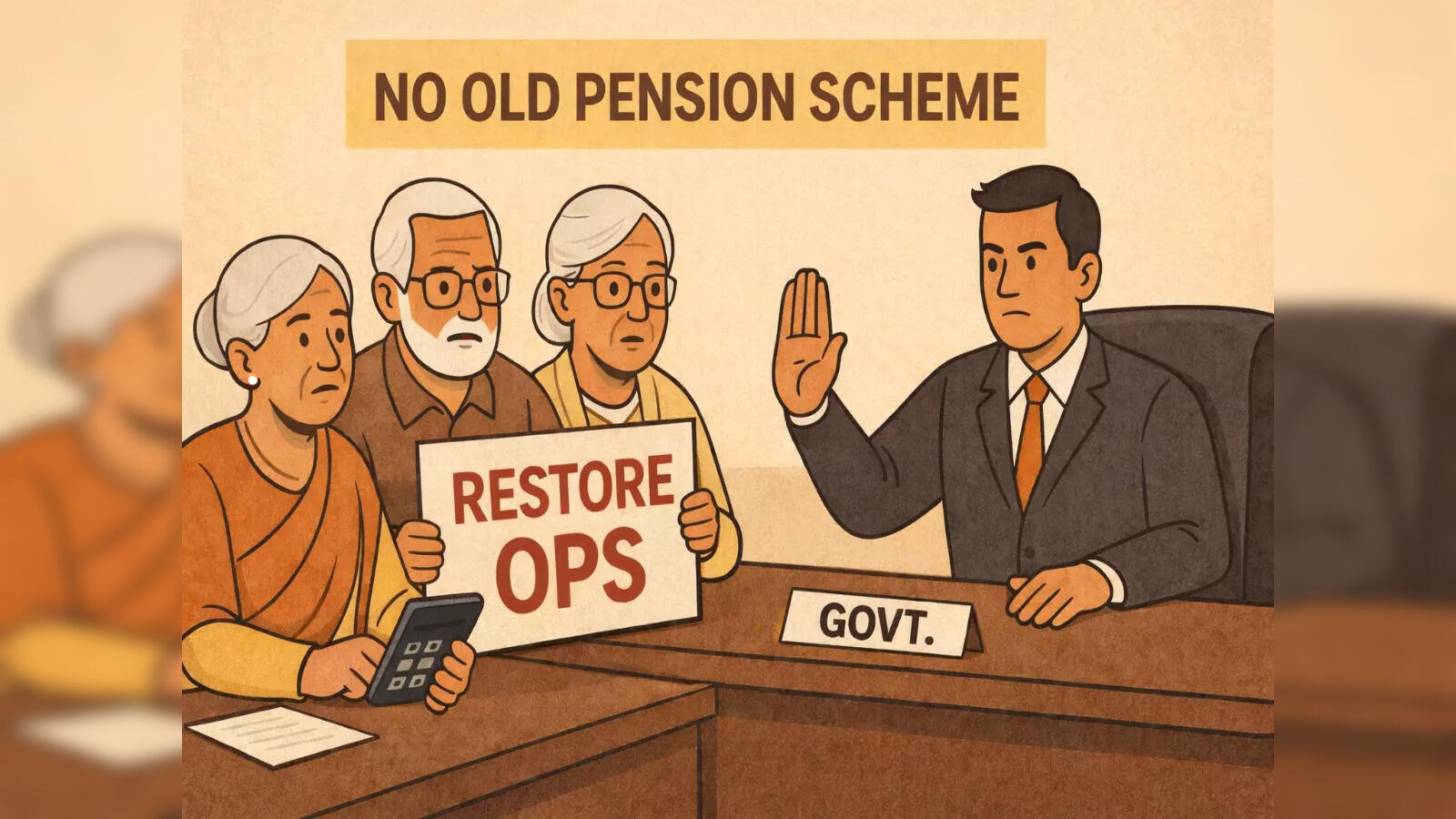
The battle lines for the 8th Pay Commission are being drawn not just over salary hikes, but over the fundamental security of retirement. On Thursday, March 5, 2026, employee unions intensified their “OPS or Nothing” stance, citing the tepid response to the government’s “middle-path” Unified Pension Scheme (UPS) as proof that central employees remain unconvinced by contribution-based models.
Add businessleague.in as a Preferred Source


With the 8th Pay Commission panel now actively meeting stakeholders, the pension debate has transitioned from a political slogan to a core industrial demand that could define the commission’s final report.
Also Read |Tamil Nadu Voter List Purge: 97 Lakh Names Deleted in SIR Phase 1
The UPS “Failure”: Why Participation is at 5%
Despite a massive push and multiple deadline extensions throughout 2025, the Unified Pension Scheme has failed to gain traction.
-
The Numbers: Out of nearly 25 lakh eligible employees, only 1,22,123 signed up by the November 30, 2025 deadline.
-
Sector Breakdown: The uptake included roughly 38,569 civil employees and 23,529 railway staff.
-
The Union Argument: Leaders from the NC-JCM argue that the 95% “holdout” proves that employees view any scheme requiring a personal contribution as inferior to the non-contributory OPS.
OPS vs. NPS vs. UPS: The Structural Divide
The debate hinges on the shift from “Guaranteed Benefit” to “Market Risk.”
| Feature | Old Pension Scheme (OPS) | National Pension System (NPS) | Unified Pension Scheme (UPS) |
| Employee Contribution | Zero | 10% of Basic + DA | 10% of Basic + DA |
| Pension Amount | Fixed (50% of last pay) | Market-linked (Uncertain) | Assured (linked to service) |
| DA Adjustment | Yes (Inflation-protected) | No | Yes (Inflation-protected) |
| Funding | Govt Exchequer | Individual Corpus | Combined Contribution |
8th Pay Commission: The Fitment Factor & Salary Buzz
Also Read |Tamil Nadu Voter List Purge: 97 Lakh Names Deleted in SIR Phase 1
While pension is the emotional heart of the struggle, the Fitment Factor is the financial engine.
-
The Demand: Unions are pushing for a fitment factor of 3.68, which would see the minimum basic pay jump to ₹26,000.
-
Current Status: The Commission is reviewing whether a lower fitment factor (around 2.86) could still result in a “record” hike due to the larger current base of Dearness Allowance (DA).
The Government’s Fiscal Defense
The Ministry of Finance has repeatedly signaled that reverting to OPS is a “fiscal impossibility” for a 2026 economy.
-
Sustainability: Officials argue that the pension bill for OPS would eventually swallow the entire state revenue of several regions.
-
The Alternative: The UPS was designed to offer the “assured” feeling of OPS with the “funding logic” of NPS. The government believes once the 8th Pay Commission scales up salaries, the UPS benefits will naturally look more attractive.
Reality Check
The demand for OPS is a powerful tool for union mobilization. Still, with the government excluding it from the ToR in November 2025, the 8th Pay Commission technically does not have the mandate to “restore” it. Therefore, while unions will use the 1.22 lakh participation figure as leverage, the more realistic “win” they are eyeing is a massive increase in the government’s contribution to NPS/UPS (potentially from 14% to 18-20%).
The Loopholes
The government says there is “no proposal” for OPS. In fact, this is a “Constitutional Loophole”—while the Centre refuses, several opposition-ruled states have already reverted to OPS. Therefore, if the 8th Pay Commission results in a lower-than-expected salary hike, the “Exodus to OPS” at the state level could force the Centre’s hand to prevent an exodus of talent. Still, the “UPS Minimum Service Loophole”—requiring 25 years for a full pension—means many mid-career switchers will never see the “assured” benefits promised by the new scheme.
Also Read |Tamil Nadu Voter List Purge: 97 Lakh Names Deleted in SIR Phase 1
What This Means for You
If you are a central government employee, the next 6 months are critical for your financial planning. First, realize that your 8th Pay Commission hike will likely be implemented from January 1, 2026 (retroactively). Then, if you are still undecided on UPS, understand that the “window” is currently closed, but the Commission may recommend a “one-time reopening” of the option once the new pay scales are announced.
Finally, understand that DA Merger rumors are false. You should not expect the DA to be merged with basic pay before the Commission’s final report. Before you plan your 2026 budget, wait for the Commission’s interim report, expected by mid-year, which will give the first real hint at the new Fitment Factor.
What’s Next
The 8th Pay Commission will conclude its stakeholder consultations by June 2026. Then, look for a nationwide protest or “Strike Ballot” by the AIDEF and Railway unions in August if the pension demand isn’t addressed. Finally, expect the final recommendations to be submitted to the Cabinet by late 2026, with implementation likely by the end of the year or early 2027.
Also Read |Tamil Nadu Voter List Purge: 97 Lakh Names Deleted in SIR Phase 1
End…
Add businessleague.in as a Preferred Source
🙏 Support Independent Journalism
We keep news free for you.
Most readers support with ₹500 ❤️
or scan QR below

Voluntary contribution. No tax benefits.
DISCLAIMER
We have taken all measures to ensure that the information provided in this article and on our social media platform is credible, verified and sourced from other Big media Houses. For any feedback or complaint, reach out to us at businessleaguein@gmail.com