


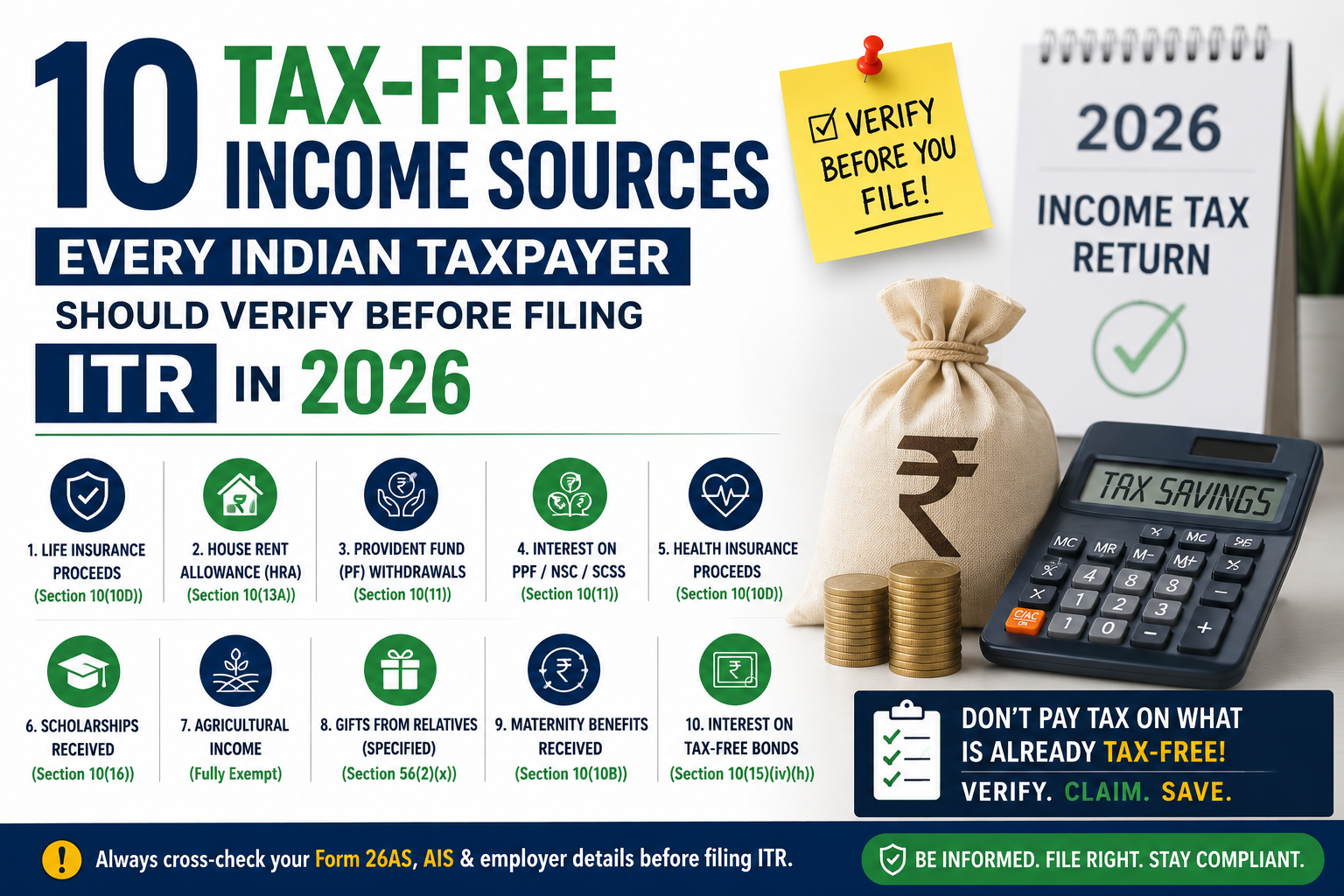
While many filers focus on maximizing standard deductions, understanding entirely tax-exempt revenue lines can reshape your long-term wealth planning.
The annual tax filing season in India often prompts a familiar race to identify investment receipts, insurance premiums, and house rent declarations. However, standard tax planning frequently overlooks a critical element of financial management: revenue streams that the law excludes from taxable calculations entirely.
Add businessleague.in as a Preferred Source


As individual taxpayers prepare their documentation for the Income Tax Return (ITR) cycle in 2026, understanding what qualifies as tax-free income in India under the Income Tax Act can significantly impact an individual’s overall liability.
By familiarizing yourself with these ten entirely exempt categories, you can ensure accurate filing while optimizing your household asset distribution.
1. Agricultural Income
Earnings derived from agricultural land located within India are completely exempt from central income tax under Section 10(1). This protective framework applies to revenue generated through direct cultivation, the commercial sale of raw farm produce, and any rental income received from leasing the farmland to active cultivators.
Also Read | Nirav Modi Case Update: London Commercial Court Orders Fugitive to Pay $10.7 Million to Bank of India
2. Distributed HUF Earnings
When a Hindu Undivided Family (HUF) operates as a separate taxable entity, the capital it distributes to individual coparceners or family members is free from additional taxation. Because the HUF assessment pool is already taxed as an independent unit, this rule prevents the exact same earnings from being taxed twice.
3. Partnership Firm Profit Share
A registered partner’s share in the net profits of a partnership firm or a Limited Liability Partnership (LLP) is fully exempt under Section 10(2A). It is critical to note that this exemption applies strictly to corporate profit splits; any separate salary, bonus, or interest on capital paid to the partner remains fully taxable under standard slabs.
4. Hereditary Assets and Family Gifts
Financial gifts received from defined linear relatives—including parents, spouses, children, and siblings—are completely tax-free regardless of the total valuation. Similarly, capital, property, or high-value physical assets passed down via an official inheritance or a registered will do not attract direct income tax liability for the recipient.
5. Educational Scholarships
Grants, fellowships, and academic scholarships awarded to deserving candidates to meet institutional tuition fees or daily educational expenses are entirely exempt from the tax net. This targeted exemption ensures that financial support for students across India remains untaxed.
6. Public and Private Gratuity Benefits
Retirement benefits receive substantial structural protection under Indian tax law. Government employees enjoy full tax immunity on the entire gratuity amount received upon superannuation. For non-government salaried professionals, gratuity payouts are exempt up to a statutory ceiling of ₹20 lakh, subject to specific service-year calculations.
Also Read | Nirav Modi Case Update: London Commercial Court Orders Fugitive to Pay $10.7 Million to Bank of India
7. Long-Term Statutory Savings Interest
The interest earned and final maturity proceeds from several flagship small-savings instruments are completely free from tax obligations. This EEE (Exempt-Exempt-Exempt) status covers critical long-term wealth building tools, including:
-
The Public Provident Fund (PPF)
-
Sukanya Samriddhi Yojana (SSY)
-
Employee Provident Fund (EPF) and Voluntary Provident Fund (VPF) frameworks, provided all compliance guidelines are met.
8. Encashment of Accumulated Leave
Salaried individuals who opt to encash their unused leave balances at the time of official retirement can claim significant exclusions. The payout is fully tax-exempt for central and state government staff. Meanwhile, non-government corporate employees can claim a deduction up to an updated maximum threshold of ₹25 lakh.
9. Completed Recognized Provident Fund Withdrawals
Lump-sum liquidations from a recognized provident fund account escape tax assessment, provided the employee has logged a minimum of five years of continuous service with registered employers. Early withdrawals prior to the five-year mark remain subject to structural tax deductions at source unless specific medical or organizational closure conditions are satisfied.
10. Life Insurance Maturity and Death Benefits
Payouts received upon the maturity of a life insurance policy, including accrued loyalty bonuses, are shielded from tax liability under Section 10(10D), subject to basic premium-to-sum-assured ratios. In the unfortunate event of the policyholder’s demise, the total death benefit passed down to nominees remains entirely exempt from income tax, regardless of the ultimate sum.
-
FAQ
Do I need to disclose tax-free income in my regular ITR form?
Yes. Entirely exempt income sources must still be reported under the “Exempt Income” schedule (such as Schedule EI) of your ITR form. Disclosing these figures helps explain the source of your investments and asset growth to the tax department without increasing your liability.
Is agricultural income completely free from all calculations?
While agricultural income is exempt from direct central income tax under Section 10(1), it is factored in under a partial integration method to determine the tax rate applicable to your non-agricultural income, provided your non-farm earnings exceed the basic exemption limit.
Are cash gifts received from friends during a wedding taxable?
Gifts received from non-relatives are tax-exempt up to an aggregate value of ₹50,000 in a single financial year. However, gifts received by an individual on the specific occasion of their wedding are completely exempt from tax, regardless of the amount or relationship.
Does the ₹25 lakh leave encashment exemption apply to mid-career resignations?
The full benefit of the statutory exemption threshold up to ₹25 lakh is legally structured for leave encashment received at the time of final retirement or superannuation. Payouts received due to normal mid-career job changes may face different tax computations depending on your service terms.
Also Read | Nirav Modi Case Update: London Commercial Court Orders Fugitive to Pay $10.7 Million to Bank of India
Add businessleague.in as a Preferred Source

