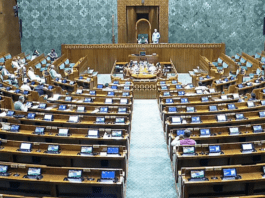
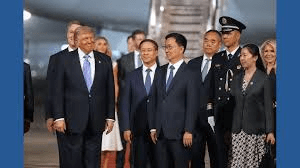
Now the halls of the Great Hall of the People are echoing with a call for global maturity. Chinese President Xi Jinping hosted US President Donald Trump in Beijing on Thursday, May 14, 2026, delivering a gentle but pointed message on responsible leadership. Therefore, as both powers navigate an increasingly unstable international order shaped by the Iran war and technology tensions, Xi urged Washington to adopt a steadier approach. Meanwhile, Trump responded with characteristic praise, calling the gathering potentially “the biggest summit ever.” Following a ceremonial welcome and an inspection of the Guard of Honour, the two leaders have entered high-stakes deliberations aimed at resetting the world’s most critical bilateral relationship.
Add businessleague.in as a Preferred Source


Also Read |Tamil Nadu Voter List Purge: 97 Lakh Names Deleted in SIR Phase 1
Xi’s Knock on the Knuckles: A Call for Global Maturity
Now the Chinese leader used his opening remarks to frame the relationship in terms of historical duty. Xi Jinping addressed Trump directly, asking if the two nations can meet global challenges together to provide more stability for the world. Therefore, the tone was less about ceremony and more about a strategic nudge toward cooperation.
First, Xi asserted that the two countries have more common interests than differences. Next, he argued that stronger ties between the US and China would contribute significantly to global stability. Thus, the Chinese side is positioning itself as the “steadier actor” in a changing world.
So the message was clear: Beijing expects Washington to view China’s growth as mutually beneficial. Meanwhile, Xi warned that both countries “stand to gain from cooperation and lose from confrontation.” Therefore, the opening of the summit has set a bar for “maturity” that the world is desperate to see met.
The G2 Paradigm: Shifting Dynamics Since the 2017 Visit
Now analysts are noting a profound shift in the balance of influence since Trump’s last trip to Beijing nine years ago. According to Ali Wyne of the International Crisis Group, the United States is now unpromptedly acknowledging China’s status. Therefore, Trump’s revival of the term “G2” to describe a US-China superpower pairing marks a major rhetorical shift.
First, during his 2017 visit, China was still trying to persuade the US of its growing status. Next, in 2026, the US is openly recognizing that status as a mechanical necessity for global governance. Thus, the relationship has evolved from an era of “engagement” to one of “superpower parity.”
So Trump arrives under mounting domestic political pressure, whereas Xi faces fewer immediate constraints. Meanwhile, this shift in dynamics is visible in the way both leaders walked shoulder-to-shoulder during the Guard of Honour inspection. Therefore, the “G2” label is no longer a theory but a diplomatic reality of the Beijing talks.
Praise and Friendship: Trump’s Opening Salvo in Beijing
Now President Trump chose to begin the meeting with the same style of personal diplomacy that characterized his first term. He repeatedly called Xi a “great leader” and expressed that it was an “honour to be your friend.” Therefore, the President is banking on personal rapport to unlock difficult trade and security concessions.
First, Trump brushed off critics of his friendly rhetoric, stating, “Sometimes people don’t like me saying it, but I say it anyway.” Next, he predicted that the relationship between the two nations is going to be “better than ever before.” Thus, the US President is framing the summit as a historic opportunity for a “grand reset.”
So while Xi focused on shared responsibility, Trump focused on the grandeur of the occasion. Meanwhile, the global community is watching to see if this “friendship” can translate into tangible solutions for the Iran conflict. Therefore, the contrast in their opening styles reflects their differing domestic priorities.
Also Read |Tamil Nadu Voter List Purge: 97 Lakh Names Deleted in SIR Phase 1
The Business Powerhouse: Musk, Cook, and Huang at the Table
Now one of the most striking aspects of Trump’s arrival was the high-profile business delegation accompanying him. Heads of the world’s most valuable tech companies, including Elon Musk, Tim Cook, and Jensen Huang, are present in Beijing. Therefore, the economic stakes of the visit are being handled by the industry’s top titans.
Tech Leaders in Beijing:
-
Elon Musk (Tesla): Looking to stabilize EV supply chains and battery manufacturing.
-
Tim Cook (Apple): Navigating the complexities of Chinese manufacturing and retail.
-
Jensen Huang (NVIDIA): Addressing the mechanical necessity of high-end chip export controls.
First, the White House hopes to secure significant commercial wins during these three days. Next, the presence of Jensen Huang is particularly critical given the ongoing “chip war” and AI development race. Thus, the business delegation is the engine room of the 2026 summit’s economic agenda.
Strategic Flashpoints: Taiwan, Chips, and AI Safeguards
Now despite the friendly opening, the list of grievances between the two nations remains long and complex. Xi is expected to press Trump on the recent increase in US arms sales to Taiwan. Therefore, the regional security of the Indo-Pacific is a “red line” that could easily derail the current momentum.
First, both leaders are engaging in deep deliberations over export controls on advanced semiconductors. Next, the issue of “AI safeguards” has become a priority as both nations race to deploy the most powerful models. Thus, the technology sector is both a field for cooperation and a theatre of rivalry.
So the goal of the summit is to create a “guardrail” for these tensions to prevent them from escalating into a direct military conflict. Meanwhile, the delegation is working on a framework for “peaceful coexistence” in the digital realm. Therefore, the tech talks are the most forward-looking part of the 2026 agenda.
Iran and Global Security: Resolving the Strait of Hormuz Crisis
Now the escalating US-Israel war on Iran is the most immediate threat to global stability discussed at the Great Hall. The blockade of the Strait of Hormuz has impacted one-fifth of the world’s oil supply, hurting both economies. Therefore, China’s influence in Tehran is a mechanical necessity for Washington.
First, the US is looking for China to play a more active role in de-escalating the maritime crisis. Next, Beijing has urged restraint while refraining from direct military involvement in the conflict. Thus, the “G2” powers must find a way to secure the global energy artery without sparking a broader war.
So the “Iran war” is the primary geopolitical pressure point for Trump’s 2026 visit. Meanwhile, the rising fuel prices are driving the domestic “austerity push” back home in America. Therefore, a breakthrough on Middle East security would be the crowning achievement of the Beijing summit.
Also Read |Tamil Nadu Voter List Purge: 97 Lakh Names Deleted in SIR Phase 1
Boeing and Beyond: The Commercial Wins on the Horizon
Now the summit is expected to yield several multi-billion dollar trade agreements. China is reportedly preparing to announce major purchases of Boeing aircraft, US agricultural goods, and liquid natural gas (LNG). Therefore, these deals are the physical evidence Trump needs to prove his “America First” strategy is working.
First, a massive Boeing order would provide a lifeline to the US aerospace industry during a period of global turbulence. Next, the agricultural deals aim to secure the loyalty of the American heartland ahead of the mid-terms. Thus, the “commercial wins” are the traditional metric for a successful state visit.
So while the broader tone is about “stability,” the subtext is about “trade balance.” Meanwhile, the extension of the rare earth minerals truce is also being negotiated behind closed doors. Therefore, the final joint statement is expected to be heavy on economic cooperation.
FAQ: Frequently Asked Questions on the 2026 Beijing Summit
1. When did Trump and Xi Jinping meet in Beijing? Now, the bilateral talks officially opened on Thursday morning, May 14, 2026, at the Great Hall of the People.
2. What was the main theme of Xi Jinping’s opening message? First, he emphasized that the US and China should be “partners, not rivals” and called for global maturity and shared responsibility.
3. Which US business leaders are in Beijing with President Trump? So the delegation includes Elon Musk of Tesla, Tim Cook of Apple, and Jensen Huang of NVIDIA.
4. What is the “G2” concept being discussed? Next, it refers to the US-China superpower pairing, acknowledging that these two nations now carry the primary burden of global stability.
5. Are they discussing the Iran war? Now, yes. The conflict’s impact on global oil markets and the Strait of Hormuz is a major point of the security deliberations.
6. What are the expected trade outcomes? Finally, reports suggest significant deals for Boeing aircraft, farm goods, and US energy products will be announced during the visit.
Also Read |Tamil Nadu Voter List Purge: 97 Lakh Names Deleted in SIR Phase 1
End…
Add businessleague.in as a Preferred Source
🙏 Support Independent Journalism
We keep news free for you.
Most readers support with ₹500 ❤️
or scan QR below

Voluntary contribution. No tax benefits.
DISCLAIMER
We have taken all measures to ensure that the information provided in this article and on our social media platform is credible, verified and sourced from other Big media Houses. For any feedback or complaint, reach out to us at businessleaguein@gmail.com