


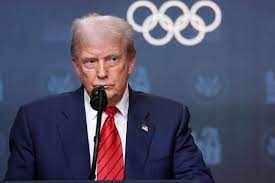
As the world’s attention pivots to Switzerland, the stakes for global security have rarely been higher. On Monday, February 16, 2026, President Donald Trump, speaking from Air Force One, confirmed his “indirect” participation in the upcoming nuclear talks with Iran.
Add businessleague.in as a Preferred Source


The Geneva summit follows a series of military escalations and a failed first round in Muscat earlier this month. While Trump expressed a belief that “Tehran wants to make a deal,” his rhetoric remained laced with warnings of “very traumatic” consequences should diplomacy fail.
Also Read |Tamil Nadu Voter List Purge: 97 Lakh Names Deleted in SIR Phase 1
Geneva Negotiations: The “Oman Model” Returns
Due to the lack of formal diplomatic ties, the talks in Geneva will follow the “Muscat Model.”
-
Mediated Dialogue: Omani officials will shuttle between separate rooms housing the Iranian delegation, led by Foreign Minister Abbas Araghchi, and the U.S. team, featuring Steve Witkoff and Jared Kushner.
-
The Deadlock: The U.S. maintains a “Zero Enrichment” policy. Conversely, Araghchi stated on X (formerly Twitter) that “submission before threats” is not on the table, signaling that Iran will not relinquish its nuclear infrastructure.
-
The IAEA Factor: Araghchi met with IAEA chief Rafael Grossi on Monday, though Grossi continues to seek clarity on Iran’s highly enriched uranium stockpiles following previous military strikes.
Also Read |Tamil Nadu Voter List Purge: 97 Lakh Names Deleted in SIR Phase 1
Military Buildup: Two Carriers and a “Sustained Campaign” Plan
The “diplomacy” in Geneva is being backed by a massive naval presence in the Arabian Sea.
-
The Armada: The USS Gerald R. Ford, the world’s largest aircraft carrier, is being rerouted from the Caribbean to join the USS Abraham Lincoln.
-
The “Phase Two” Threat: U.S. officials have leaked that the military is prepared for a “sustained campaign” if the Geneva round collapses. This follows the shooting down of an Iranian drone near the USS Lincoln on February 4.
-
Deterrence: Trump noted that Iran learned the “consequences” of a hardened stance last summer, referring to the June 2025 bombings of Iranian nuclear sites.
Also Read |Tamil Nadu Voter List Purge: 97 Lakh Names Deleted in SIR Phase 1
Investigative Angle: The Fallout of “Midnight Hammer”
Our investigation into the 2025 conflict, dubbed “Operation Midnight Hammer,” reveals why both sides are at the table now.
The Strategy: The June 2025 strikes by U.S. B-2 stealth bombers targeted the Natanz, Fordow, and Isfahan facilities. While these strikes severely hampered Iran’s enrichment capabilities, they did not eliminate the “knowledge base.” Our sources indicate that Iran has since decentralized its research into deep-mountain bunkers, making a “final” military solution nearly impossible without a full-scale war. This “technical stalemate” is precisely why the Trump administration is pushing for a permanent diplomatic “freeze” rather than just a pause.
Also Read |Tamil Nadu Voter List Purge: 97 Lakh Names Deleted in SIR Phase 1
[U.S.-IRAN NUCLEAR DEADLOCK: KEY POSITIONS (FEB 2026)]
| Issue | U.S. / Israel Position | Iran Position |
| Uranium Enrichment | Zero Enrichment (Dismantle infrastructure) | Right to Peaceful Enrichment (NPT) |
| Existing Stockpiles | Must leave the country | Retain for medical/energy use |
| Ballistic Missiles | Must be part of the deal | Non-negotiable (Defense matter) |
| Sanctions | Snap-back remains; relief after proof | Immediate relief as a precondition |
Iran’s Defiant Drills: Chemical and Naval Preparedness
On the eve of the talks, Tehran hasn’t remained silent.
-
Chemical Defense: The civil defense organization held a major drill at the Pars Special Economic Energy Zone on Monday to prepare for “chemical incidents” at energy hubs.
-
Naval Posture: The IRGC began live-fire exercises in the Strait of Hormuz, testing drone swarms and anti-ship missiles.
-
The Messaging: By testing defenses at its vital oil export routes, Iran is reminding the U.S. and the global market of the “cost” of another military escalation.
Next Steps
If you are tracking global energy markets, you should monitor Brent Crude prices throughout Tuesday, as any sign of a breakdown in Geneva could send oil above $95/barrel. Furthermore, if you are following U.S. domestic policy, you should watch for the “Board of Peace” meeting on February 19, which Trump suggests will deal with the broader regional security framework beyond just the nuclear issue.
Also Read |Tamil Nadu Voter List Purge: 97 Lakh Names Deleted in SIR Phase 1
End…
Add businessleague.in as a Preferred Source

