
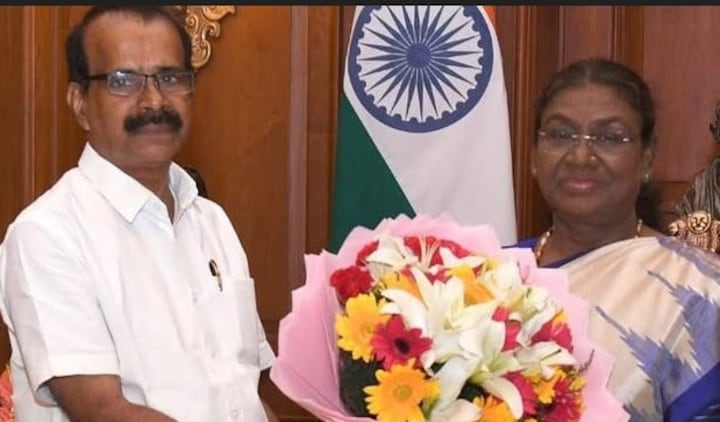
Acting on the formal advice of Prime Minister Narendra Modi under Article 75, the head of state clears the departure of the prominent Kerala leader alongside portfolio cuts for fellow minister Ravneet Singh Bittu.
Add businessleague.in as a Preferred Source


The administrative channels and structural balances that govern the Union executive, mandate member status for cabinet heads, and regulate legislative seat distributions across the upper house of Parliament have triggered a high-profile exit. Issuing an official press communique from the Rashtrapati Bhavan on Tuesday morning, June 23, 2026, President Droupadi Murmu formally finalized the George Kurian resignation Council of Ministers order. The immediate clearance strips the veteran Kerala leader of his executive functions, drawing a close to his dual-ministry role inside the third Narendra Modi-led administration.
The executive vacancy follows a calculated realpolitik shift within the ruling party’s legislative strategy.
Kurian, a lawyer by training who served as a prominent Christian face for the Bharatiya Janata Party (BJP) in the southern peninsula, was initially brought into the cabinet in June 2024.
To satisfy the strict law forcing ministers to secure a parliamentary seat within six months, he was elected via an August 2024 bypoll to complete the remainder of a Rajya Sabha seat in Madhya Pradesh.
Because that localized term officially expired on June 21, 2026, his continuation in office required a fresh nomination that the party high command chose not to grant.
Also Read | Viral Trump Lookalike Buffalo Rescue: Saved From Eid Sacrifice
The Architecture of the Exit: Unpacking the Six-Month Constitutional Barrier
The structural trigger behind the minister’s departure does not point to internal policy rifts or governance failures. Instead, it runs on the strict rules set by Article 75 of the Constitution of India.
Under Article 75, Clause 5, any minister who operates without holding a seat in either the Lok Sabha or the Rajya Sabha for a consecutive six-month window automatically loses their executive office.
While Kurian could have technically used that un-elected grace period to stay in power temporarily, the party’s choice to field National General Secretary Tarun Chugh for the Madhya Pradesh seat made his long-term exit certain.
Consequently, rather than keeping an un-elected official in office, the prime minister advised an immediate exit to prepare for an upcoming cabinet reshuffle.
Slicing Through the Evolving Union Executive Vacancy Sheet
The recent upper house election cycle has removed two sitting ministers from parliament, forcing immediate portfolio changes across the central executive:
| Outgoing Union Minister | Affected State Portfolio Desks | Expired Rajya Sabha Seat Hub | New Rajya Sabha Replacement Field | Active Operational Impact Profile |
| George Kurian (Resigned) | Minority Affairs / Fisheries & Dairy | Madhya Pradesh Bench | Tarun Chugh (Elected Unopposed) | Vacates key minority seat; portfolios return to the PM’s pool. |
| Ravneet Singh Bittu | Ministry of State Food Processing / Rail | Rajasthan Bench | Satish Poonia (Elected Unopposed) | Leaves the minister without a seat; triggers high reshuffle chatter. |
| Nitin Nabin (Party Shift) | Broad Organizational Strategy | Regional State Oversight | Nitin Nabin (Selected as President) | Shifts attention to state-level assembly election grids. |
Note: Following standard procedures, the executive duties for the vacated Minority Affairs and Fisheries bureaus will be temporarily reassigned to senior cabinet ministers until the Prime Minister finalizes a broad mid-year cabinet expansion.
The underlying text of the Rashtrapati Bhavan statement reveals that the resignation was filed in strict accordance with established democratic rules.
A native of Ettumanoor in Kottayam, Kurian has climbed through the party’s ranks since its inception in 1980, practicing law before the Supreme Court and serving as the vice-chairman of the National Commission for Minorities.
His sudden exclusion from the parliamentary lists hints at a broader strategy to reposition key organizational faces ahead of upcoming state assembly elections next year.
Also Read | Viral Trump Lookalike Buffalo Rescue: Saved From Eid Sacrifice
Five Sequence Steps Executed by the State to Process a Cabinet Resignation
To ensure a major leadership change inside the Union Council of Ministers meets all legal standards without delaying everyday government business, the Cabinet Secretariat implements this five-step sequence:
Ultimately, managing the shifts detailed in the George Kurian resignation Council of Ministers case study requires a clear understanding of India’s constitutional mechanics. While regional administrations adjust to immediate local challenges—such as the active western disturbances capping summer heatwaves across Delhi-NCR this week—central political planners remain focused on long-term structural organization.
By following strict constitutional timelines, maintaining steady leadership balances, and preparing for future legislative sessions, the government ensures its core executive frameworks stay completely stable.
Tracking these political shifts early helps you stay ahead of upcoming policy updates, keeping your understanding of national governance perfectly aligned as the country’s leadership framework evolves.
FAQ Section
What caused the sudden George Kurian resignation Council of Ministers announcement today?
The resignation was triggered by the completion of his Rajya Sabha tenure representing Madhya Pradesh, which officially ended on June 21, 2026. Because the ruling party chose to field National General Secretary Tarun Chugh for the seat instead of renominating Kurian, his departure became a constitutional necessity.
Which specific portfolios are affected by this central executive resignation?
Kurian served as the Minister of State within two separate federal branches: the Ministry of Minority Affairs and the Ministry of Fisheries, Animal Husbandry and Dairying. Following his official departure, these duties will be temporarily reassigned to other cabinet leaders by the Prime Minister.
What does Article 75(5) dictate regarding un-elected ministers in the cabinet?
Article 75(5) of the Constitution of India establishes a strict safety rule, stating that a minister must be a member of either the Lok Sabha or the Rajya Sabha. If an un-elected individual holds a cabinet post for six consecutive months without winning a parliamentary seat, they automatically lose their right to continue in office.
Also Read | Viral Trump Lookalike Buffalo Rescue: Saved From Eid Sacrifice
End…
Add businessleague.in as a Preferred Source
🙏 Support Independent Journalism
We keep news free for you.
Most readers support with ₹500 ❤️
or scan QR below

Voluntary contribution. No tax benefits.
DISCLAIMER
We have taken all measures to ensure that the information provided in this article and on our social media platform is credible, verified and sourced from other Big media Houses. For any feedback or complaint, reach out to us at businessleaguein@gmail.com