
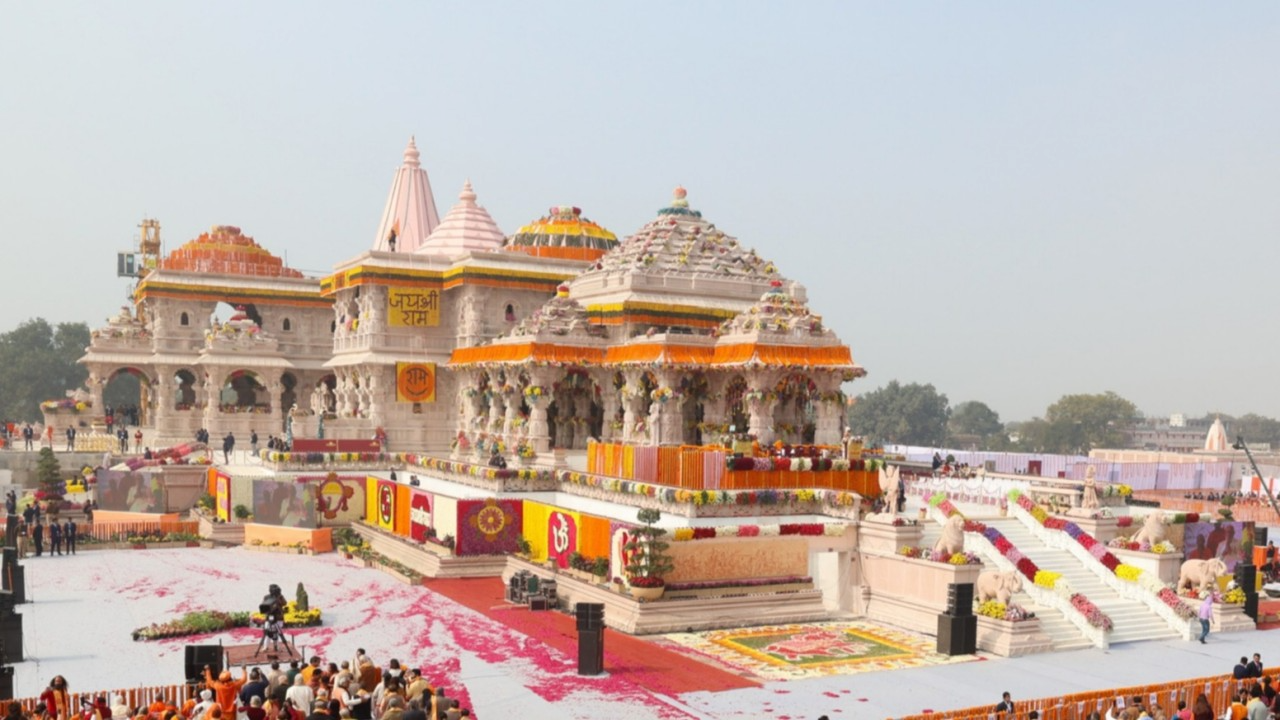
LUCKNOW — Investigations into the financial management of India’s highest-profile religious shrine took a decisive turn on Thursday night. Law enforcement officials confirmed the arrest of eight individuals directly integrated into the cash-clearing infrastructure at the Ram Temple in Ayodhya. The arrests come in the wake of an intensifying controversy involving the suspected siphoning of approximately ₹7.5 crore from the temple’s secure donation receptacles.
Add businessleague.in as a Preferred Source


The sweep marks a sharp shift in tone from early June. When initial whispers of accounting discrepancies surfaced, senior political figures, including Uttar Pradesh Deputy Chief Minister Brajesh Pathak, publicly dismissed the reports as a politically motivated “false narrative.“
Similarly, executives within the independent Shri Ram Janmabhoomi Teerth Kshetra Trust initially maintained that their structural coordination with the State Bank of India (SBI) left zero room for operational leaks.
However, face-to-face friction escalated rapidly, prompting the Trust to request a formal external intervention. On June 13, the state government formed a Special Investigation Team (SIT). The unit submitted its confidential preliminary findings to the Additional Chief Secretary (Home) on June 23, immediately triggering the late-night arrests of key members of the counting room personnel.
Also Read | Institutional Deficits Uncovered: Deconstructing the Ram Temple Donation Theft Row SIT Logs
The Arrested Syndicate: Roles and Interpersonal Links
According to the First Information Report (FIR) filed under the new Bharatiya Nyaya Sanhita (BNS) guidelines, the systemic drainage of assets was orchestrated not by external agents, but by an interdependent cell operating inside the temple’s counting pavilion.
The state has pressed charges under BNS Sections 306 (theft by clerk or servant), 316 (criminal breach of trust), 317 (dishonestly receiving stolen property), and 61 (criminal conspiracy).
Key Accused and Recoveries in the Investigation:
• Ram Shankar "Tinnu" Yadav: Keyholder, former driver to Trust leadership; allegedly directed arbitrary box access.
• Subhash Shrivastava: Retired banking official deployed to manage the collection team.
• Avinash Shukla: Temple attendant; investigators tracked ₹5 lakh directly to his personal bank account.
• Ramashankar Mishra & Family: Accused of embedding a son and son-in-law into the room to spirit away funds.
• Manish Yadav: Nephew of Tinnu Yadav; physical currency was recovered directly from his residence.
The most prominent face under scrutiny is Ram Shankar Yadav, alias Tinnu Yadav, a figure deep within the local network who previously served as the personal driver for the Trust’s general secretary, Champat Rai. Investigators allege that Yadav utilized his close institutional relationships to exercise unchecked control over the physical keys to the large collection trunks. While Yadav has denied wrongdoing, attributing the case to malicious professional rivalries, police point to coordinated actions among his extended family, including his nephew Manish Yadav, from whose property a portion of the stolen currency was recovered.
The conspiracy allegedly relied on multi-generational access points. Fellow operator Ramashankar Mishra stands accused of exploiting his position to place his son, Anukalp Mishra—who has personal family ties to Trustee Anil Mishra—and his son-in-law, Lavkush Mishra, directly into the counting room. The SIT believes Lavkush Mishra was tasked with transporting the hidden cash, and early search sweeps reported direct cash discoveries inside his home.
The oversight apparatus was further compromised by Subhash Shrivastava, a former banking professional explicitly hired to guide the technical staff, and Karunesh Pandey, who allegedly manipulated data logs on validation receipts.
Also Read | Institutional Deficits Uncovered: Deconstructing the Ram Temple Donation Theft Row SIT Logs
Structural Vulnerabilities in High-Volume Operations
The operational scale of the Ayodhya shrine explains how discrepancies reached such heights unnoticed. Since its formal inauguration by Prime Minister Narendra Modi in January 2024, the complex has drawn massive financial offerings.
Audited internal books released in September 2025 demonstrated that the Trust generated an annual revenue of ₹327 crore for the preceding fiscal year, with raw public donations bringing in a massive ₹153 crore alongside ₹173 crore in pure investment interest.
Ram Temple Daily Footfall Metrics:
• Regular Weekday Attendance: 70,000 to 80,000 pilgrims per day
• Weekend and Holiday Surges: 210,000 to 240,000 pilgrims per day
• Processing Infrastructure: 4 massive primary trunks cleared by 14 authorized workers
To manage the volume of physical notes deposited by up to 240,000 weekend visitors, the Trust contracted the State Bank of India to oversee collection logistics. The banking giant subsequently brought in a private security agency to run the daily clearance procedures. The actual collection floor utilized a designated 14-person sorting line consisting of 11 bank professionals and three representatives from the Trust.
Prakash Gupta, the temple trust camp office in-charge, previously observed that all counter-based transactions are completely protected by a digital double-receipt protocol. Analysts suggest that the loophole occurred entirely within the unrecorded drops made inside the anonymous primary boxes before formal processing began.
While police prepare to present the eight detainees before a local magistrate for extended interrogation, political pressure is mounting. Opposition leaders have characterized the current arrests as an administrative diversion, demanding that the investigation panel expand its inquiry to fix direct liability on senior Trust administrators who managed the compromised facility.
FAQ
How did the counting team bypass security protocols to smuggle cash out?
The SIT’s initial findings indicate that the conspirators took advantage of their unmonitored positions around the raw donation trunks. Because certain individuals held key-access privileges and oversaw the operational staff, they could hide bundles of high-denominator currency before the notes were run through computerized counters.
What is the current legal status of the eight individuals arrested?
The eight accused individuals were rounded up by local police units within Ayodhya and are being held in temporary police lockups. Law enforcement is filing procedural paperwork to present them before a judicial magistrate to obtain an extended custody remand for deeper interrogation.
Will the State Bank of India face penalties for the security breach?
While the SBI was the primary corporate entity authorized to manage cash collections, the bank sub-contracted the physical labor pool to an external agency. The investigation is currently analyzing whether the institution violated service-level security agreements or demonstrated oversight negligence.
Does the ₹327 crore revenue figure represent only liquid cash donations?
No. The ₹327 crore figure declared in the Trust’s late-2025 financial disclosures represents its total annual earnings pool. Within that matrix, direct physical and digital public donations accounted for ₹153 crore, while the remaining ₹173 crore was generated through structured interest on fixed deposits.
Also Read | Institutional Deficits Uncovered: Deconstructing the Ram Temple Donation Theft Row SIT Logs
Add businessleague.in as a Preferred Source
🙏 Support Independent Journalism
We keep news free for you.
Most readers support with ₹500 ❤️
or scan QR below

Voluntary contribution. No tax benefits.
DISCLAIMER
We have taken all measures to ensure that the information provided in this article and on our social media platform is credible, verified and sourced from other Big media Houses. For any feedback or complaint, reach out to us at businessleaguein@gmail.com