


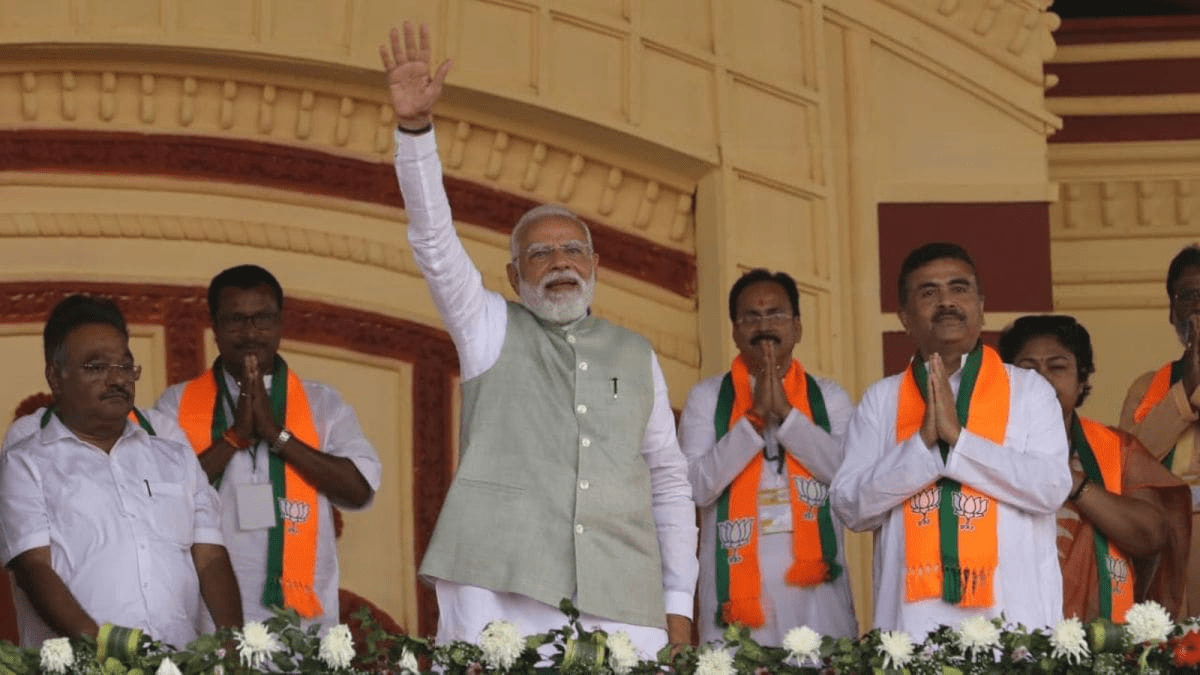
Now the 2026 West Bengal Assembly election campaign has entered a high-voltage phase of slogans and promises. Prime Minister Narendra Modi added a sharp new dimension to his political vocabulary this Thursday. First, he introduced the term “Sabka Hisab” (Accountability for All) to his famous signature slogan. Therefore, the Modi Sabka Hisab vow 2026 signals a massive crackdown on corruption if the BJP comes to power. Addressing a sea of supporters in Birbhum’s Suri, Modi asserted that the “looting of Bengal” must end. Meanwhile, the Trinamool Congress has dismissed the vow as a political gimmick.
Add businessleague.in as a Preferred Source


Also Read |Tamil Nadu Voter List Purge: 97 Lakh Names Deleted in SIR Phase 1
Evolution of a Slogan: From Vikas to Hisab
Now we must track how the Prime Minister’s messaging has changed over the last decade. First, he launched “Sabka Sath, Sabka Vikas” in 2014 to focus on inclusive growth. Therefore, it became the foundation of his first term.
Next, he added “Sabka Vishwas” in 2019 and “Sabka Prayas” before the 2024 general elections. Thus, the brand has grown with every major poll cycle.
[Image showing the timeline of PM Modi’s slogans from 2014 to 2026]
Meanwhile, the Modi Sabka Hisab vow 2026 adds a layer of “justice” to the development narrative. Therefore, the BJP is positioning itself as the party of law and order in a state marred by political friction. So “Hisab” is the new keyword for the Bengal voter.
The Birbhum Rally: A Message to the Rank and File
So why did Modi choose Birbhum to launch this new vow? First, Birbhum has been a flashpoint for political violence and coal-smuggling allegations. Therefore, the theme of “accountability” resonates deeply here.
Next, BJP sources indicate that the slogan is meant to boost the morale of ground-level workers. Many are still afraid of the consequences if the party fails to win this time. Thus, the Prime Minister is personally guaranteeing their safety.
Meanwhile, Modi used the same slogan in Haldia and Asansol on the same day. Therefore, it is officially the central theme of the BJP’s second phase of campaigning. So the party is shifting from “hope” to “consequences.”
Six Major Promises: The BJP’s 2026 Roadmap
Now the Prime Minister didn’t just stop at a slogan; he listed a concrete roadmap for a BJP government. First, he promised to replace the current “atmosphere of fear” with “trust.” Therefore, security is the top priority on the list.
Modi’s Six Vows for Bengal:
-
Reopening all cases of scams and crimes against women.
-
Direct accountability of the administrative machinery to the public.
-
Jailing all corrupt officials, from ministers to watchmen.
-
Implementing the 7th Pay Commission immediately.
-
Identifying and punishing those involved in atrocities since 2021.
-
Ensuring all “looted money” is accounted for.
Thus, the BJP is running on a platform of “Total Cleansing.” Meanwhile, the administration is being warned that their current actions are being recorded.
Also Read |Tamil Nadu Voter List Purge: 97 Lakh Names Deleted in SIR Phase 1
7th Pay Commission: A Masterstroke for State Employees?
So how does the BJP plan to win over the massive state government workforce? First, Modi pledged that the 7th Pay Commission would be implemented as soon as the government is formed. Therefore, he is targeting a demographic that has long been unhappy with the current dearness allowance (DA) rates.
Next, this promise could flip thousands of votes in urban centers like Calcutta and Siliguri. Thus, the economic incentive is being paired with the justice narrative.
Meanwhile, the Trinamool government has struggled with these payments due to fiscal constraints. Therefore, the BJP is framing this as a choice between “mismanagement” and “central-level benefits.” So the 7th Pay Commission is a major economic weapon in this election.
Bhabanipur Battle: Adhikari vs. Banerjee Again
Now the fight for Bhabanipur has become the symbolic center of the 2026 polls. First, Modi claimed that the “Nandigram result” will be repeated in Bhabanipur this year. Therefore, he is predicting another direct defeat for Mamata Banerjee.
Next, Leader of the Opposition Suvendu Adhikari is contesting against the CM once again. Thus, the rivalry that defined 2021 has been revived for 2026.
Meanwhile, Adhikari was present at the Haldia rally where Modi made these claims. Therefore, the entire central machinery of the BJP is backing Adhikari’s bid to unseat the Chief Minister. So Bhabanipur is no longer just a seat; it is a referendum on the TMC’s survival.
Addressing the Trauma of 2021 Post-Poll Violence
So why is “accountability” such a sensitive word in Bengal? First, the BJP reminds voters of the violence that occurred after the 2021 results. Therefore, they claim that over 60 workers were killed and many more displaced.
Next, the party admits that many supporters are still “afraid on the ground.” Thus, the Modi Sabka Hisab vow 2026 is an attempt to convince them that the “tide has turned.”
Meanwhile, by promising to identify and punish those involved in these atrocities, Modi is acting as a protector. Therefore, the slogan is designed to turn fear into a vote for “retribution.” So the trauma of the past is being used to build the victory of the future.
Also Read |Tamil Nadu Voter List Purge: 97 Lakh Names Deleted in SIR Phase 1
Trinamool’s Rebuttal: Kunal Ghosh Questions BJP’s Ethics
Now the Trinamool Congress has struck back with its own set of questions. First, leader Kunal Ghosh questioned how Modi can talk about “accountability.” Therefore, he pointed to leaders from other parties who faced corruption charges and then joined the BJP.
Next, the TMC calls the “Sabka Hisab” slogan a hypocritical attempt to mislead voters. Thus, they claim the BJP is actually the “safe haven” for the corrupt.
Meanwhile, the ruling party insists that they have already addressed governance issues. Therefore, they view the BJP’s promises as “external interference.” So the debate has become a war of “who is more corrupt.”
The Accountability Layer: Identifying ‘Looters’
Now let’s look at the legal implications of the “Hisab” vow. First, Modi promised that no one would be spared, “regardless of how powerful they were.” Therefore, he is hinting at potential investigations into top-level TMC ministers.
Next, he mentioned that the PMO is keeping a close watch on the administrative machinery. Thus, he is signaling that central agencies like the ED and CBI will remain active.
Meanwhile, the BJP believes this message will win over the “silent majority” who feel cheated by local-level scams. Therefore, the Modi Sabka Hisab vow 2026 is the ultimate promise of a “New Bengal.” So the countdown to May 4 has officially begun with a pledge of accountability.
Common Questions Answered
What is the ‘Sabka Hisab’ vow? Now it is PM Modi’s new campaign promise for the 2026 Bengal polls. Therefore, it focuses on holding corrupt individuals and criminals accountable.
Will the 7th Pay Commission be implemented in Bengal? First, PM Modi has officially promised to implement it as soon as a BJP government is formed. Thus, it is a major election pledge.
Who is contesting against Mamata Banerjee in Bhabanipur? Next, Suvendu Adhikari is challenging the CM in Bhabanipur while also contesting from Nandigram. Therefore, it is a high-profile rematch.
Why did Modi add ‘Hisab’ to the slogan? So he wants to send a message of “justice” to voters and a “moral boost” to party workers who faced violence in 2021.
When are the results of the 2026 Bengal elections? Finally, the counting is scheduled for May 4, 2026. Therefore, that is the day of the final “Hisab.”
What cases did Modi promise to reopen? Actually, he specifically mentioned cases related to scams and crimes against women. So the focus is on safety and financial integrity.
Also Read |Tamil Nadu Voter List Purge: 97 Lakh Names Deleted in SIR Phase 1
End….
Add businessleague.in as a Preferred Source

