


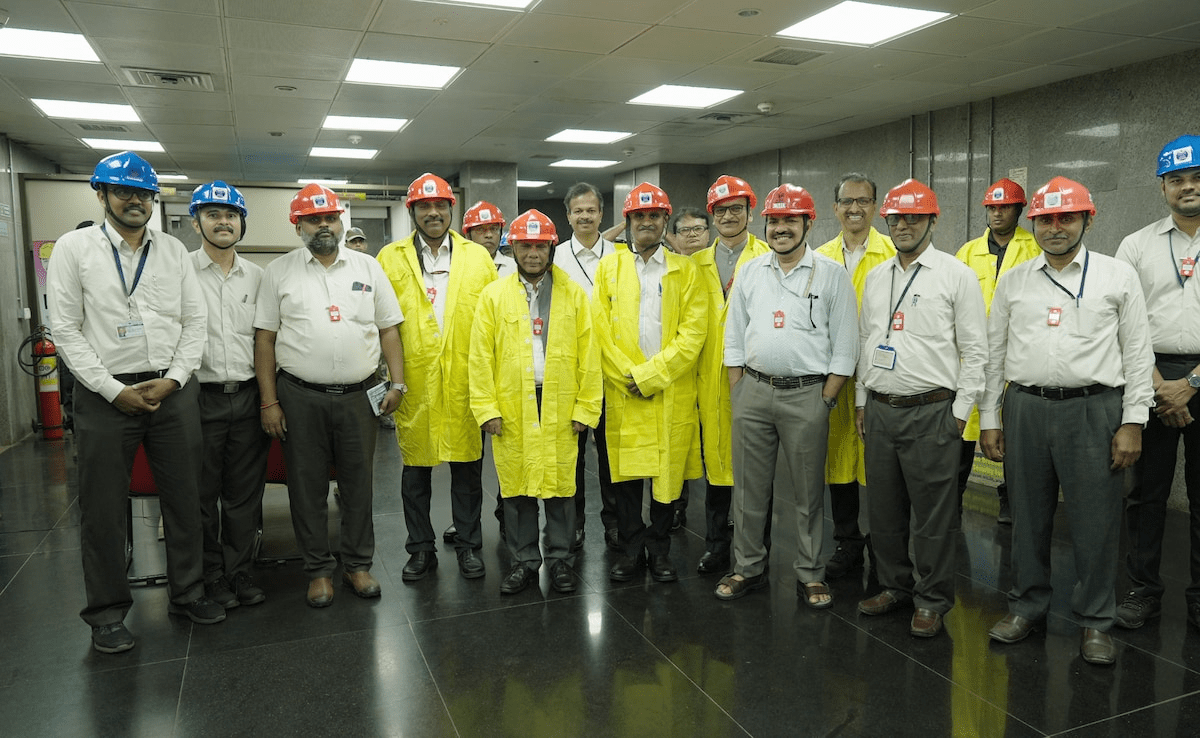
Now India has officially crossed the most consequential threshold in its civil nuclear history. The Prototype Fast Breeder Reactor (PFBR) at Kalpakkam reached its first criticality this week. Therefore, a sustained nuclear fission reaction is finally established in the country’s first commercial-scale fast breeder. This Kalpakkam PFBR criticality milestone 2026 marks the realization of Dr. Homi J. Bhabha’s three-stage nuclear vision. Meanwhile, Top scientist Dr. Sreekumar G. Pillai has called this the “Akshay Patra” moment—a mythical vessel of endless energy sustenance for the nation.
Add businessleague.in as a Preferred Source


Also Read |Tamil Nadu Voter List Purge: 97 Lakh Names Deleted in SIR Phase 1
What is the “Akshay Patra” Moment?
Now we must understand why scientists are using mythical terms for a nuclear reactor. First, the PFBR is designed to produce more fissile material than it consumes. Therefore, once it reaches equilibrium, it sustains itself indefinitely.
Next, Dr. Sreekumar G. Pillai, Director of IGCAR, explained that there is no need to look for external fuel sources. Thus, it acts like the “Akshay Patra”—a vessel that never runs dry.
Meanwhile, this milestone provides the strategic direction for India’s long-term energy security. Therefore, the Kalpakkam PFBR criticality milestone 2026 is a defining moment for our national sovereignty. So the dream of endless energy for centuries is no longer just a vision.
The Technological Leap: PHWR vs. PFBR
So how does this differ from our existing nuclear plants? First, our first-stage reactors (PHWRs) use natural uranium as fuel. Therefore, they form the current backbone of India’s fleet but have limitations.
Next, these PHWRs produce Plutonium-239 as a byproduct. Thus, the PFBR takes that plutonium and uses it to jumpstart the second stage.
Meanwhile, the PFBR operates in a “fast neutron spectrum.” Therefore, the neutrons are not slowed down, allowing for a much more efficient reaction. So this represents a massive jump in engineering complexity and power potential.
Why Liquid Sodium was the Biggest Challenge
Now let’s talk about the 20-year journey to get here. First, fast breeder reactors use liquid sodium as a coolant. Therefore, heat transfer is incredibly efficient, but the risks are high.
Next, liquid sodium reacts violently with both air and water. Thus, it requires extraordinary engineering precision to keep it contained.
Meanwhile, Dr. Pillai noted that this was a necessary learning curve for India. Therefore, the country had to develop its own sensors and materials reliability protocols. So while the project faced delays, the resulting “institutional memory” is unique to Indian science.
Also Read |Tamil Nadu Voter List Purge: 97 Lakh Names Deleted in SIR Phase 1
The Science of Breeding: Making More Fuel Than You Burn
Now for the lay audience, the concept of a “breeder” sounds almost magical. First, the reactor has a “breeding ratio” greater than one. Therefore, you get more plutonium out of the reactor than what you fed into it.
Next, current oxide fuels expect a breeding ratio of 1.03 to 1.05. Thus, for every 100 units of fuel burned, the reactor creates 105 units of new fuel.
Meanwhile, research into metallic fuels could push this ratio even higher. Therefore, the reactor is essentially a fuel factory that also generates electricity. So the Kalpakkam PFBR criticality milestone 2026 solves the problem of limited uranium reserves.
Reprocessing: Mastery of the Closed Fuel Cycle
So how do we get the plutonium to fuel these breeders? The secret is the “closed fuel cycle.” First, India has built indigenous reprocessing capabilities since the 1960s. Therefore, we can extract plutonium from the spent fuel of thermal reactors.
Next, the IGCAR facility has matured the “PUREX” process from Trombay to Kalpakkam. Thus, we have scaled up our capacity to support the next set of reactors.
Meanwhile, the PFBR will generate its own spent fuel to support the upcoming FBR-1 and FBR-2 units. Therefore, the fuel chain is now complete and self-sustaining. So India is no longer dependent on international uranium markets for this stage.
Security and Safety: Handling Sodium Risks
Now safety concerns are always a priority with sodium-cooled reactors. First, IGCAR has decades of experience handling this reactive metal. Therefore, they have developed special powders and sensors to mitigate any risks of fire.
Next, the facility follows the “defense-in-depth” philosophy. Thus, there are multiple layers of containment to ensure the sodium stays within the pipes.
Meanwhile, the Atomic Energy Regulatory Board (AERB) developed unique safety codes for this project. Therefore, India has created its own regulatory roadmap where international literature was unavailable. So the Kalpakkam PFBR criticality milestone 2026 is a victory for safety engineering as much as physics.
Also Read |Tamil Nadu Voter List Purge: 97 Lakh Names Deleted in SIR Phase 1
Thorium: The Final Gateway to Energy Independence
So what is the ultimate goal of the PFBR? It is the bridge to the third stage of our nuclear program. First, India has some of the world’s largest thorium reserves. Therefore, the PFBR uses thorium as a “blanket” material.
Next, when thorium is hit by neutrons in the breeder, it produces Uranium-233. Thus, Uranium-233 becomes the fuel for the final, endless stage of energy production.
Meanwhile, this transition will help India achieve total energy independence. Therefore, we will not need to look for fuel from any external source for centuries. So the Kalpakkam PFBR criticality milestone 2026 is the key that unlocks our coastal sands.
Net Zero 2070: Nuclear Power as Baseload Energy
Now let’s look at the environmental impact. India aims to achieve Net Zero carbon emissions by 2070. First, solar and wind are great but they are not always available. Therefore, we need a “clean baseload” power source that runs 24/7.
Next, the PFBR provides exactly that—low-carbon, high-capacity electricity. Thus, it is a stepping stone toward our climate goals.
[Image showing a clean energy grid with nuclear and renewables combined]
Meanwhile, the reactor will eventually power millions of households without the need for coal. Therefore, the success at Kalpakkam is a win for the planet. So we are building a green “Viksit Bharat” through advanced nuclear technology.
Common Questions Answered
What is the Kalpakkam PFBR criticality milestone 2026? Now it is the moment India’s first commercial-scale fast breeder reactor achieved a self-sustaining chain reaction. Therefore, it marks a huge leap in nuclear technology.
Why is it called the ‘Akshay Patra’ of energy? First, because it produces more fuel than it consumes. Thus, it provides a seemingly endless supply of energy sustenance.
When will it start producing commercial power? Next, it is expected to reach commercial power production in about six to eight months. Therefore, late 2026 will see the first units on the grid.
Does India have enough fuel for this? So yes. Through our mastery of the closed fuel cycle and reprocessing, there is no issue of plutonium availability.
Is it safe given the use of liquid sodium? Finally, yes. IGCAR has decades of experience and multiple containment layers to manage sodium risks. Thus, it follows global safety standards.
What is the role of Thorium? Actually, the PFBR uses thorium to create Uranium-233. This is the fuel for the third stage, leading to centuries of energy independence.
Also Read |Tamil Nadu Voter List Purge: 97 Lakh Names Deleted in SIR Phase 1
End….
Add businessleague.in as a Preferred Source

