


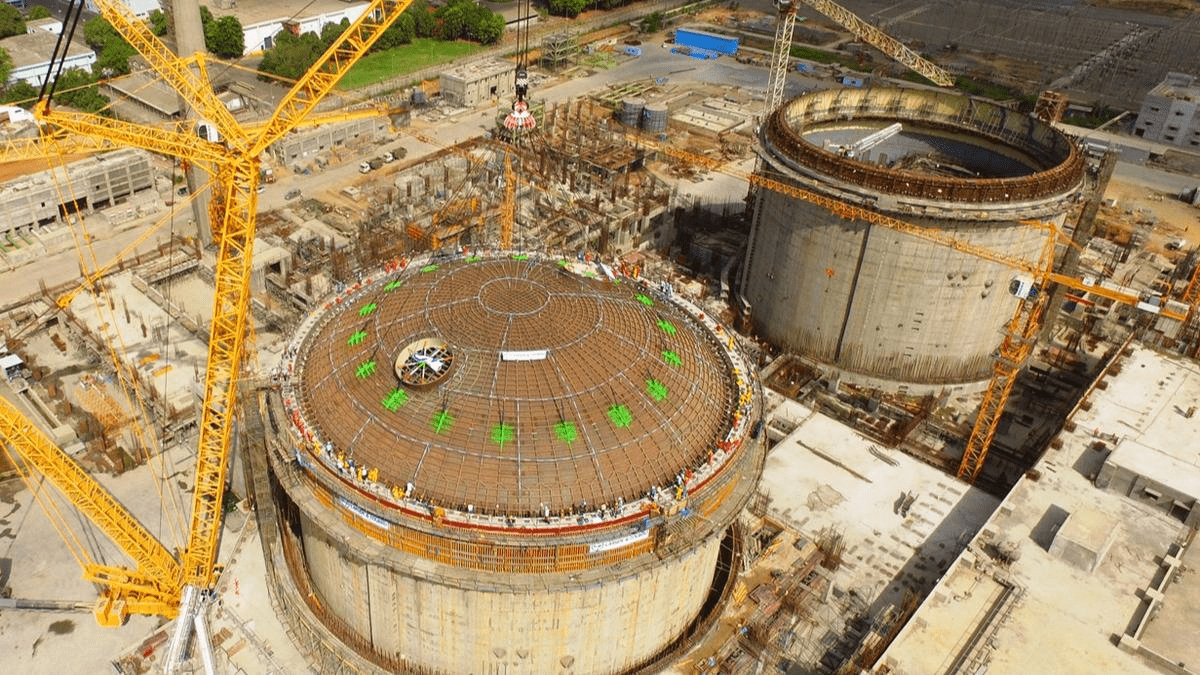
In a historic leap for global energy science, India’s Prototype Fast Breeder Reactor (PFBR) at Kalpakkam, Tamil Nadu, attained criticality on Monday, April 6, 2026. This 500 MWe reactor is a scientific marvel: it is designed to produce more fuel than it consumes, a feat only one other country (Russia) has achieved at a commercial scale.
Add businessleague.in as a Preferred Source


Prime Minister Narendra Modi hailed the event as a “defining step” toward India’s long-term goal of energy independence through its vast, indigenous thorium reserves.
Also Read |Tamil Nadu Voter List Purge: 97 Lakh Names Deleted in SIR Phase 1
Science Explained: How a “Breeder” Reactor Works
Most nuclear reactors are like conventional engines that simply burn fuel. The PFBR, however, acts as both an engine and a fuel factory.
-
The Fuel: It uses MOX (Mixed Oxide) fuel, a blend of uranium and plutonium oxides.
-
The Coolant: Instead of water, it uses liquid sodium kept at 200°C. Sodium is more efficient at transferring heat and doesn’t slow down the “fast” neutrons needed for the breeding process.
-
The “Breeding” Process: The reactor core is surrounded by a “blanket” of Uranium-238. As the core undergoes fission, intense neutron bombardment converts this fertile blanket into Plutonium-239, which can then be harvested as fresh fuel.
-
Criticality: This is the “heartbeat” moment where the nuclear chain reaction becomes self-sustaining. It means the reactor is now running on its own steady internal “fire” without needing an external trigger.
India’s 3-Stage Nuclear Vision
Planned in the 1950s by physicist Homi Bhabha, this program aims to move India away from importing rare uranium and toward using its own soil.
Also Read |Tamil Nadu Voter List Purge: 97 Lakh Names Deleted in SIR Phase 1
| Stage | Technology | Fuel Used | Key By-product |
| Stage 1 | Pressurised Heavy Water Reactors (PHWR) | Natural Uranium | Plutonium |
| Stage 2 | Fast Breeder Reactors (PFBR) | Plutonium + Uranium | More Plutonium |
| Stage 3 | Thorium-based Reactors | Thorium + U-233 | Sustained Power |
Why Thorium is the “Holy Grail”
While India holds only 1-2% of global uranium, it possesses nearly 25% of the world’s thorium in the monazite sands of its southern coasts.
-
Energy Potential: Thorium could power India for 400 years, generating up to 500 GW of electricity.
-
The Catch: Thorium cannot split (fission) on its own. it must first be “cooked” inside a fast breeder reactor like the one at Kalpakkam to turn into Uranium-233.
Investigative Insight: A 70-Year Gamble Pays Off
The Kalpakkam PFBR has faced decades of engineering delays and international sanctions, but its success marks a shift in the global energy hierarchy. By building this reactor indigenously with the help of 200 Indian industries, India has bypassed the “Uranium Cartel.”
However, the road ahead is still technical. Achieving criticality is the “gateway,” not the finish line. The reactor will now undergo low-power physics experiments for several months before it is finally connected to the national grid. If successful, the Department of Atomic Energy plans to build six more breeder reactors by 2030, potentially making India a global leader in carbon-free, self-sustaining base-load power.
Also Read |Tamil Nadu Voter List Purge: 97 Lakh Names Deleted in SIR Phase 1
End….
Add businessleague.in as a Preferred Source

