


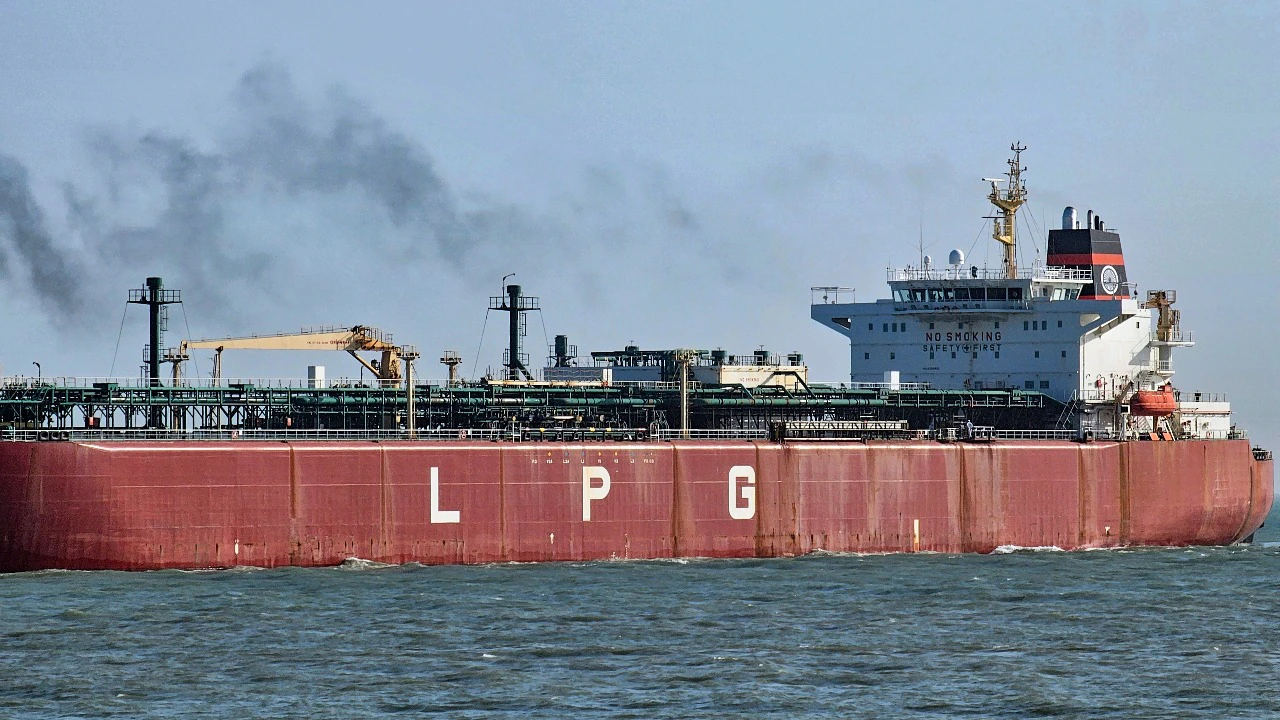
While the world’s superpowers trade missile strikes, the quiet work of keeping Indian kitchens running continues. Today, Saturday, March 21, 2026, the global energy market is watching two specific dots on the map: the Pine Gas and the Jag Vasant. Their journey represents the first major test of whether commercial shipping can survive the current Iran-US-Israel conflict.
Add businessleague.in as a Preferred Source


Also Read |Tamil Nadu Voter List Purge: 97 Lakh Names Deleted in SIR Phase 1
The “Pine Gas” and “Jag Vasant” Mission
Currently positioned near Sharjah, UAE, these two tankers are “flagged” for movement.
-
Pine Gas: Operated by Indian Oil Corporation (IOC), carrying thousands of metric tonnes of pressurized LPG.
-
Jag Vasant: Chartered by Bharat Petroleum (BPCL). Both ships had “dropped anchor” earlier this week following the surge in hostilities but have now resumed broadcasting their AIS (Automatic Identification System) signals, indicating an imminent departure for Indian ports.
The Mechanics of “Selective Passage”
The Strait of Hormuz is not technically “closed”—it is “commercially unviable” for most. However, Tehran is practicing what analysts call “Sanctioned Selection.”
-
US/UK/Israel Flags: These vessels are being turned back or targeted by IRGC fast-attack crafts.
-
Neutral Flags: Ships from India, China, and Pakistan are being allowed through on a “case-by-case” basis, often after high-level diplomatic “clearance” from Tehran.
Also Read |Tamil Nadu Voter List Purge: 97 Lakh Names Deleted in SIR Phase 1
Domestic Impact: India’s LPG Buffer
India imports nearly 60% of its LPG consumption. With the war entering its fourth week, domestic reserves are beginning to deplete. If these two tankers successfully cross, it will provide a much-needed 10-day buffer for Indian bottling plants. Without them, the government may be forced to implement LPG rationing by early April.
Reality Check
The “Safe Passage” granted to India is fragile. While Iran views India as a “neutral partner,” any perceived cooperation between the Indian Navy and the U.S. Fifth Fleet could revoke this privilege instantly. The fact that no crude tankers moved in the last 24 hours suggests that while gas (LPG) is being allowed through, the “big oil” that fuels global economies is still being held hostage as a geopolitical bargaining chip.
The Loopholes
The MEA calls for “unhindered movement.” In fact, this is a “Diplomatic Loophole”—by framing it as a humanitarian necessity (cooking gas for civilians), India is able to bypass the “war zone” restrictions that apply to crude oil. Still, the “Insurance Loophole” remains; even if Iran allows the ships to pass, Western insurance firms (like Lloyd’s of London) may refuse to cover the “War Risk,” leaving the Indian government to provide sovereign guarantees for any damage or loss.
Also Read |Tamil Nadu Voter List Purge: 97 Lakh Names Deleted in SIR Phase 1
What This Means for You
If you are a consumer in India, don’t panic-buy LPG cylinders just yet. First, realize that the “Selective Passage” is currently working, and these two ships carry enough gas to stabilize the immediate supply chain.
Then, if you are a traveler, understand that the “War Surcharge” on logistics is real. While the gas might arrive, the cost of “War Risk Insurance” will eventually be passed down to the consumer, likely leading to a ₹50–₹100 hike in cylinder prices by next month. Finally, understand that shipping delays are inevitable; a journey that usually takes 4 days is now taking 12 due to “anchor-and-wait” protocols.
What’s Next
Expect the Indian Navy’s INS Kolkata or INS Tarkash to provide a “visible presence” (though not a direct escort) near the ships as they exit the Gulf tonight. Then, look for a statement from IOC/BPCL by Monday confirming the “discharge” of the cargo at Mangalore or Mundra ports. Finally, expect the U.S. to monitor these transits closely to see if Iran is using “neutral” ships to mask its own oil movements.
Also Read |Tamil Nadu Voter List Purge: 97 Lakh Names Deleted in SIR Phase 1
End….
Add businessleague.in as a Preferred Source

