


Mid-Plate Shockwave: Historically Rare Magnitude 6.1 Earthquake Off Cuba Rattles Florida and Mexico
The strongest Gulf fracture instrumentally recorded since 1880 breaks dynamic intraplate baselines, forcing multi-city emergency evacuations across Miami and Cancun.
Add businessleague.in as a Preferred Source


The structural architecture of the Gulf of Mexico has experienced a rare, high-magnitude intraplate tectonic rupture. According to emergency telemetry verified by the United States Geological Survey (USGS) and international seismological centers, a historically powerful magnitude 6.1 earthquake struck off Cuba’s northwestern coastline on Monday afternoon.
The primary shock wave struck precisely at 2:00 PM Eastern Daylight Time (EDT) on June 8, 2026, originating at a mid-crustal depth of 10 kilometers. The epicenter was mathematically mapped within the marine limits of the Yucatan Basin, positioned approximately 104 kilometers west-northwest of the Cuban town of Mantua and 100 kilometers off the island’s western tip. The resulting shock waves traveled outward across the oceanic floor, triggering localized building evacuations across regions historically considered completely safe from severe seismic threats.
Also Read | Viral Trump Lookalike Buffalo Rescue: Saved From Eid Sacrifice
Anatomy of an Ultra-Rare Intraplate Anomaly
The primary characteristic that has stunned global geophysical observatories is the earthquake’s unusual location. The vast majority of global seismic activity occurs along active plate boundaries, where tectonic plates rub against each other. Monday’s rupture occurred entirely within the stable core of the North American plate structure.
“This event is extremely rare,” explained William Barnhart, a senior geophysicist with the USGS, during a technical review. “It’s the largest earthquake ever recorded in the Gulf of Mexico with modern instruments, which date back to the 1950s. It’s one of only five or six earthquakes of magnitude five or greater that we’re aware of in the entire Gulf history.”
Historical data logs show that no seismic event of comparable strength has broken through within 320 kilometers of the epicenter since 1880, when an estimated magnitude 6.0 tremor damaged structures near San Cristóbal, Cuba.
Multi-National Shockwave Impact Logs
Because the high-frequency waves faced minimal resistance while traveling through the stable, un-fractured bedrock of the mid-plate interior, the energy traveled hundreds of miles, rattling multiple countries.
| Major Municipal Node | Distance from Epicenter | Recorded Local Intensity Profile | Primary Emergency Actions Deployed |
| Pinar del Río, Cuba | ~154 Kilometers | Classified as Intensity V (Strong Shaking) | Panicked residents fled into open roads; localized telecommunications dropped. |
| Havana, Cuba | ~210 Kilometers | Classified as Intensity IV (Moderate Shaking) | 20 seconds of continuous swaying; high-density historic sectors evacuated. |
| Cancún & Tulum, Mexico | ~240 Kilometers | Classified as Intensity IV (Moderate Shaking) | Hotel zones and commercial office high‑rises executed rapid evacuations. |
| Miami, Florida (US) | ~430 Kilometers | Classified as Intensity III (Light Shaking) | Evacuated the 28‑story government high‑rise; suspended elevated rail loops. |
| Orlando, Florida (US) | ~610 Kilometers | Classified as Intensity II (Weak Shaking) | Upper-floor apartment dwellers logged swinging ceiling fixtures. |
In Havana, the sudden 20-second tremor caused widespread panic across the historic city center, forcing office workers and residents out of old, vulnerable structures. The situation remains highly complex across western Cuba, where an ongoing domestic economic crisis has left a significant portion of the residential housing stock structurally degraded and prone to collapse under minor stress. Furthermore, pre-existing, widespread grid blackouts have hindered regional communication efforts between Civil Defense hubs and rural towns.
Also Read | Viral Trump Lookalike Buffalo Rescue: Saved From Eid Sacrifice
South Florida High-Rises Evacuated
The shockwaves traveled northward across the Florida Straits, causing significant alarm in cities unfamiliar with seismic movement. The National Weather Service (NWS) branch in Miami faced an immediate surge of citizen reports from Fort Lauderdale, Naples, Sarasota, and Tampa Bay.
In Sarasota and Fort Lauderdale, office employees reported that their heavy desks, chairs, and office equipment rolled side-to-side for close to a minute, with upper-floor office workers experiencing brief moments of dizziness as the skyscrapers’ internal damping systems moved to absorb the horizontal energy.
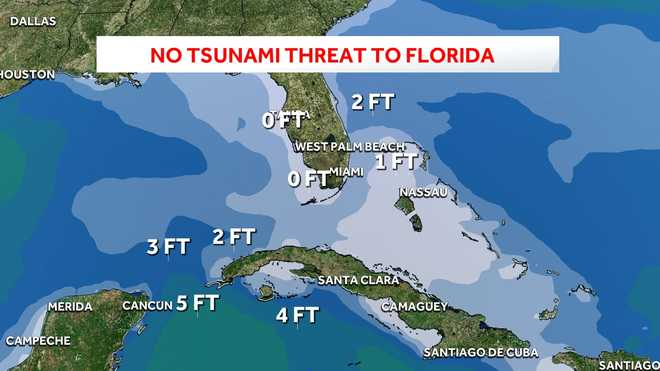
Tsunami Safety Assessment: Because the strike-slip motion of the fault line shifted the ocean floor horizontally rather than vertically, it lacked the displacement needed to generate dangerous ocean waves. The US National Tsunami Warning Center formally ruled out any significant tsunami threats for the Gulf coastlines within an hour of the initial rupture, noting only a very small, harmless water ripple near the western tip of Cuba.
As emergency crews across Mexico, Cuba, and Florida complete their structural safety sweeps, scientists warn that western Cuba should brace for minor, localized aftershocks over the coming weeks. However, geophysicists reassure residents along the US Gulf Coast that these secondary micro-shocks will not possess the physical energy needed to travel across the Gulf floor, leaving Florida’s towers safe from further midnight surprises.
FAQ Section
Why was the magnitude 6.1 earthquake off Cuba considered so unusual?
The earthquake was highly unusual because it occurred within the interior of a stable tectonic plate (intraplate) rather than along a traditional plate boundary. Seismologists confirmed it is the strongest earthquake instrumentally recorded in the Gulf of Mexico since modern monitoring systems were established in the mid-20th century.
Did the major Caribbean earthquake generate a tsunami warning?
No. The US National Weather Service and the National Tsunami Warning Center confirmed that no tsunami watches or warnings were issued. The specific horizontal motion of the fault line did not displace the volume of seawater required to generate a dangerous tsunami wave.
What cities in Florida and Mexico felt the seismic tremors?
In Florida, noticeable shaking was recorded across Miami, Fort Lauderdale, Orlando, Sarasota, and Tampa Bay, leading to high-rise building evacuations. In Mexico, the tremors were felt clearly across the Yucatán Peninsula, prompting evacuations in the tourist hubs of Cancún, Playa del Carmen, and Tulum.
Also Read | Viral Trump Lookalike Buffalo Rescue: Saved From Eid Sacrifice
End…..
Add businessleague.in as a Preferred Source

