


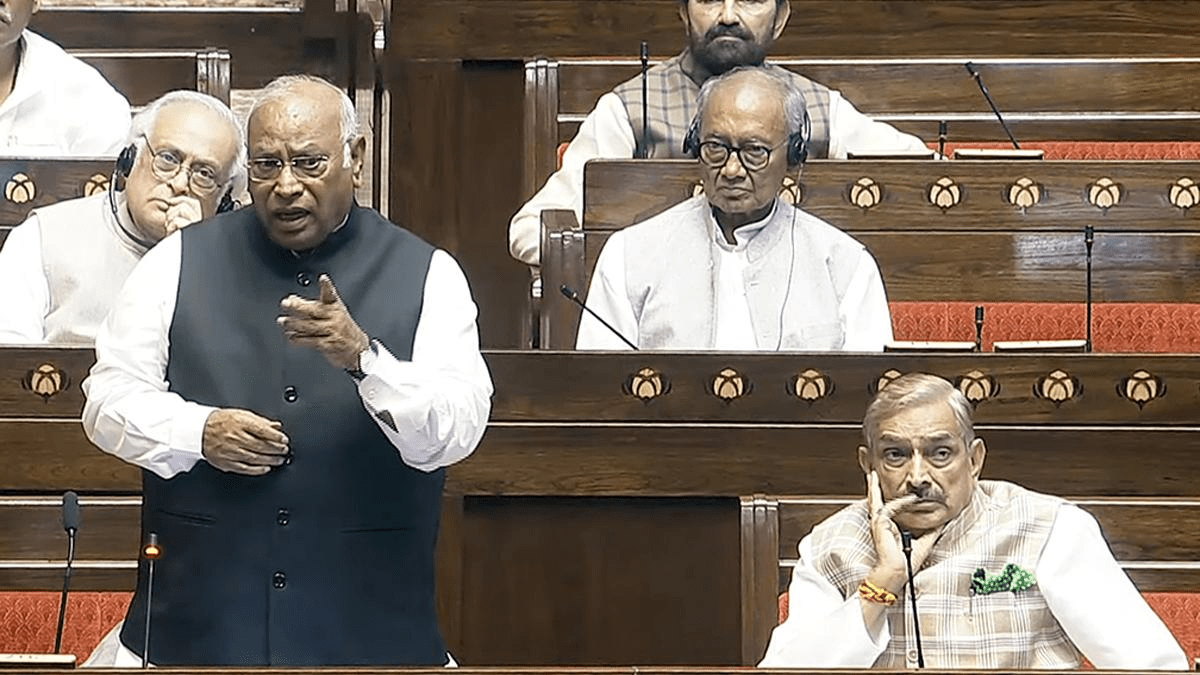
The Rajya Sabha witnessed a fiery exchange on Wednesday, April 1, 2026, as Opposition Leader Mallikarjun Kharge and Parliamentary Affairs Minister Kiren Rijiju traded blows over the government’s handling of the West Asia energy crisis. The confrontation centered on the rejection of a short-duration discussion on soaring fuel and LPG prices, which have spiked following the US-Iran maritime conflict.
Add businessleague.in as a Preferred Source


While Kharge accused the government of “strangling democracy” by bypassing debate, Rijiju slammed the Opposition for politicizing a national emergency.
Also Read |Tamil Nadu Voter List Purge: 97 Lakh Names Deleted in SIR Phase 1
The “Rule 176” Standoff
Kharge highlighted that he had written twice to Chairman C.P. Radhakrishnan requesting an urgent discussion under Rule 176, only to be met with silence while the government pushed through its own legislative agenda.
-
Opposition’s Charge: Kharge argued that while the world is “getting ruined” by the LPG crisis, the government is only interested in passing the CAPF Bill and Insolvency and Bankruptcy Code (Amendment) Bill via voice votes.
-
Government’s Defense: Rijiju countered that both the Petroleum Minister and the Prime Minister had already issued statements, and Finance Minister Nirmala Sitharaman had provided a detailed roadmap for price control.
The “All-Party” No-Show: Who Skipped Whom?
The debate took a personal turn when Rijiju accused Rahul Gandhi and Mallikarjun Kharge of skipping a high-level all-party meeting on the West Asia conflict.
Also Read |Tamil Nadu Voter List Purge: 97 Lakh Names Deleted in SIR Phase 1
| Argument | Kiren Rijiju (Government) | Mallikarjun Kharge (Opposition) |
| Attendance | “LoPs of both Houses did not attend the crucial all-party meeting.” | “I sent my representatives. Where was your Prime Minister?” |
| Commitment | Accused the Opposition of “doing politics” when the country needs unity. | Refused to attend just to “listen to a lecture” if the PM is absent. |
| Tone | “The LoP wants to abuse the Prime Minister all the time.” | “I condemn such a statement. You must withdraw it.” |
Context: The “Hormuz Chokehold”
The parliamentary heat reflects the real-world crisis outside the House:
-
LPG Surge: Commercial LPG prices jumped by ₹195.50 today, the fifth hike in 2026.
-
ATF Volatility: Aviation fuel briefly touched a record ₹2.07 lakh per kl before a partial rollback for domestic carriers.
-
Oil Benchmark: Brent Crude remains volatile at $105.53, leaving India’s energy security in a precarious state.
Investigative Insight: The “Voice Vote” Vacuum
The government’s reliance on voice votes to pass the CAPF and IBC amendments amidst a walkout or protest is a strategic maneuver to maintain legislative momentum during a geopolitical crisis. However, Kharge’s frustration stems from a deeper procedural bottleneck: if a short-duration discussion under Rule 176 is allowed, the government would be forced to face a structured Q&A on the ₹2.07 lakh ATF spike and the ₹160 XP100 petrol price. By steering the conversation toward “skipping meetings,” the Treasury benches are successfully shifting the narrative from “Economic Failure” to “Political Irresponsibility.” As the Strait of Hormuz remains blocked, this parliamentary gridlock ensures that while the ministers talk “unity,” the common citizen continues to pay the “war tax” at the petrol pump.
Also Read |Tamil Nadu Voter List Purge: 97 Lakh Names Deleted in SIR Phase 1
End…..
Add businessleague.in as a Preferred Source

