
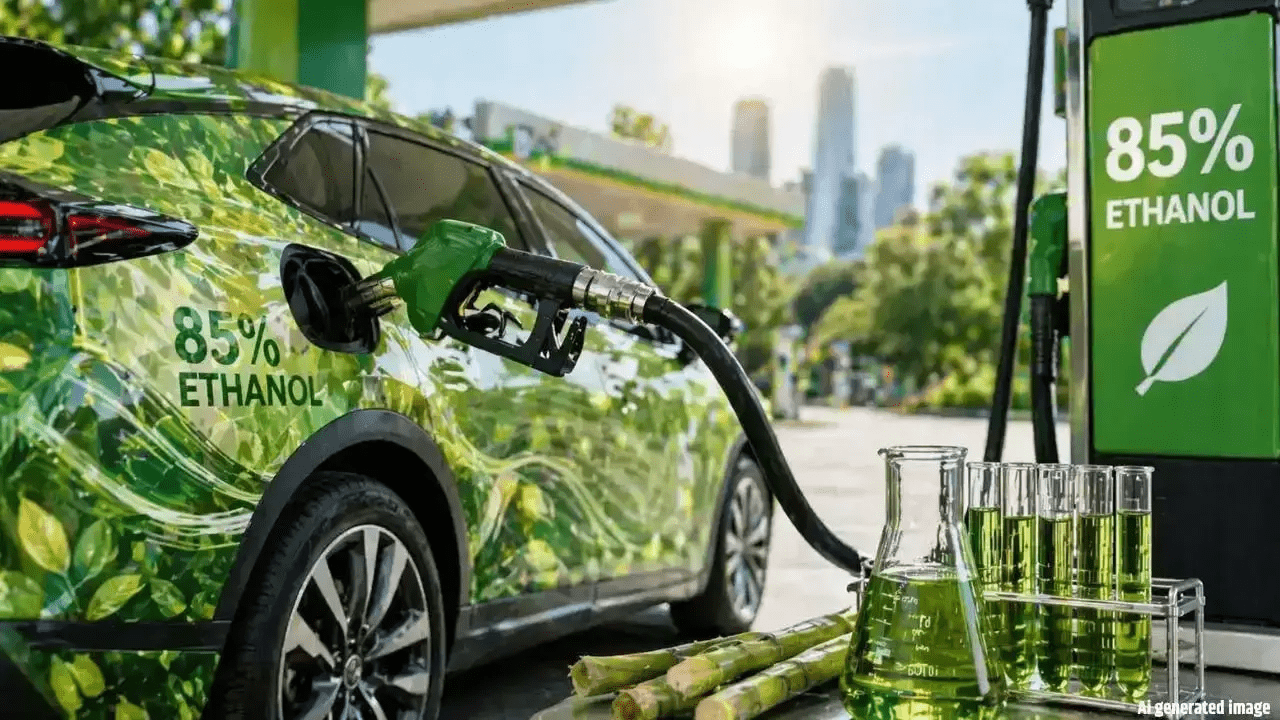
Now the Indian automotive sector is navigating a period of intense policy acceleration. Just as consumers were adjusting to the realities of E20—and its impact on mileage—the conversation has taken an unexpected turn. Therefore, the E85 fuel transition India is now the focus of the ethanol-blending roadmap. Specifically, E85 is not merely an incremental step like the move from E10 to E20; it represents a fundamental shift in vehicle engineering and national fuel infrastructure.
Add businessleague.in as a Preferred Source


Meanwhile, manufacturers are racing to showcase “Flex-Fuel” prototypes.
But for millions of current car owners, the question remains: will your existing vehicle survive this aggressive leap toward 85% ethanol?
Also Read |Tamil Nadu Voter List Purge: 97 Lakh Names Deleted in SIR Phase 1
E20 to E85: A Paradigm Shift, Not Just a New Blend
Now the push toward E85 is driven by strong economic and environmental logic. India aims to reduce oil import dependence and support domestic agriculture through increased ethanol demand. Therefore, the E85 fuel transition India is viewed as a strategic necessity.
An Aggressive Phase
First, the transition cannot rely on interim fixes or quick conversions. Then, unlike E20, E85 is expected to be introduced as a separate fuel grade rather than a direct replacement for standard petrol. Thus, the policy intent is to create a parallel market for Flex-Fuel Vehicles (FFVs). Next, the transition is significantly more complex than the earlier move from E10 to E20. Therefore, the “leap” requires a complete overhaul of the supply chain.
Why the E10-to-E20 Move was “Evolutionary”
Now we must recall that the move from E10 to E20 was relatively manageable. Many modern engines could handle E20 within their existing tolerance ranges. Therefore, the transition felt gradual.
Minor Adaptations
First, E20 compatibility was often achieved through minor ECU recalibrations or simple aftermarket modules. Then, small upgrades to fuel lines or seals were sufficient to improve compatibility. Thus, while there were minor downsides like lower fuel efficiency, the shift wasn’t disruptive to the core design of the engine. Next, the industry could rely on “interim fixes.” Therefore, the evolutionary nature of E20 allowed the market to settle without major technological friction.
The Engineering Barrier: Why E85 Demands Ground-Up Redesign
Now we face a completely different challenge. Ethanol behaves differently from petrol at concentrations of 85%. Therefore, the E85 fuel transition India demands a ground-up rethink of engine internals.
Redesigning the Core
First, ethanol burns hotter and is significantly more corrosive. Then, a sophisticated Engine Control Unit (ECU) must be designed to detect ethanol content in real time to adjust ignition timing. Thus, conventional engines designed for E20 cannot simply be “converted.” Next, the hardware changes range from fuel system materials to engine internals like piston rings and valves. Therefore, retrofitting existing vehicles for E85 is neither technically straightforward nor cost-effective.
Also Read |Tamil Nadu Voter List Purge: 97 Lakh Names Deleted in SIR Phase 1
Corrosion and Moisture: The Chemical Reality of High Ethanol
Now the chemistry of E85 is the primary obstacle for longevity. High ethanol blends easily absorb moisture from the air. Therefore, fuel systems must be “ethanol-hardened” to prevent premature failure.
Component Degradation
First, standard seals and hoses in current E20 cars can degrade rapidly when exposed to E85. Then, the higher moisture content leads to corrosion of metal fuel lines and tanks. Thus, the long-term reliability of a retrofitted vehicle becomes a major concern. Next, cold-start systems must be reworked because high ethanol blends are less volatile in lower temperatures. Therefore, an E85-compatible vehicle must be a “hardened” piece of machinery from the factory.
Early Adopters: Suzuki and Honda’s Flex-Fuel Strategy
Now a glimpse of this future is already visible in India’s two-wheeler segment. Manufacturers like Suzuki and Honda are leading the way with dedicated flex-fuel models. Therefore, the technology is already proving its viability on Indian roads.
Engineering Excellence
First, the Suzuki Gixxer SF 250 Flex Fuel features a revised internal engine and an adaptive ECU. Then, the Honda CB300F Flex Fuel offers stable performance across a wide range of ethanol concentrations. Thus, the riding experience remains unchanged despite the complex engineering beneath the surface. Next, these bikes prove that high ethanol blends can deliver performance. Therefore, the two-wheeler segment is acting as a successful testbed for the wider passenger vehicle market.
Infrastructure Hurdles: Storage and Dispensing for OMCs
Now the rollout of E85 depends as much on the pump as it does on the car. Oil Marketing Companies (OMCs) face a massive logistical challenge. Therefore, infrastructure readiness is the secondary bottleneck.
Separate Storage Systems
First, fuel stations will need dedicated, separate storage and dispensing systems for E85. Then, clear labeling will be essential to ensure consumers do not fill non-flex-fuel vehicles with the high-ethanol blend. Thus, this adds a layer of cost and complexity for OMCs who are already managing the E20 transition. Next, the nationwide distribution of E85 requires a consistent supply of high-grade ethanol from sugar mills. Therefore, the entire agricultural-to-automotive chain must be synchronized.
Also Read |Tamil Nadu Voter List Purge: 97 Lakh Names Deleted in SIR Phase 1
What Happens to Your Current E10/E20 Car?
Now we come to the most critical concern for owners: the fate of the existing fleet. Most current cars are only engineered for E10 or E20. Therefore, the E85 fuel transition India poses a risk to their resale value and longevity.
Impractical to Modify
First, running E85 in a non-flex-fuel vehicle leads to erratic combustion and long-term engine damage. Then, any attempt at conversion would be too costly for the average owner to justify. Thus, a rapid, blanket transition to E85 would effectively render a vast number of current vehicles impractical to use. Next, the shift in a logical sense seems far ahead. Therefore, experts suggest that E85 should only be introduced as an optional fuel grade for the next 5-10 years.
The Economic Logic vs. Consumer Awareness
Now for the transition to work, consumers must understand the benefits and risks. Educating users about fuel compatibility is essential to prevent costly mechanical mistakes.
Supporting Domestic Agriculture
First, the economic logic of reducing oil imports is undeniable. Then, supporting domestic farmers through ethanol production strengthens the rural economy. Thus, there is a strong “patriotic” and environmental push for E85. Next, consumer feedback about lower efficiency with E20 must be addressed before moving to E85. Therefore, the government and OMCs must balance the “green narrative” with the practical reality of vehicle running costs.
Common Questions Answered
What is E85 fuel? Now E85 is a high-ethanol blend consisting of 85% ethanol and 15% petrol. It is primarily intended for Flex-Fuel Vehicles (FFVs).
Can I run E85 in my current E20-compatible car? First, no. Running E85 in a standard E20 car can cause severe corrosion, seal degradation, and engine damage.
Which companies are making E85 vehicles in India? Next, Suzuki and Honda have already introduced flex-fuel versions of the Gixxer 250 and CB300F. Therefore, the two-wheeler market is leading the charge.
Why does E85 need a different ECU? So an adaptive ECU is required to detect ethanol content in real time and adjust fuel delivery and ignition timing for optimal combustion.
Will E85 replace standard petrol in India? Finally, it is highly unlikely in the near term. E85 will likely be offered as a separate, optional fuel grade alongside standard blends.
Also Read |Tamil Nadu Voter List Purge: 97 Lakh Names Deleted in SIR Phase 1
End….
Add businessleague.in as a Preferred Source
🙏 Support Independent Journalism
We keep news free for you.
Most readers support with ₹500 ❤️
or scan QR below

Voluntary contribution. No tax benefits.
DISCLAIMER
We have taken all measures to ensure that the information provided in this article and on our social media platform is credible, verified and sourced from other Big media Houses. For any feedback or complaint, reach out to us at businessleaguein@gmail.com