


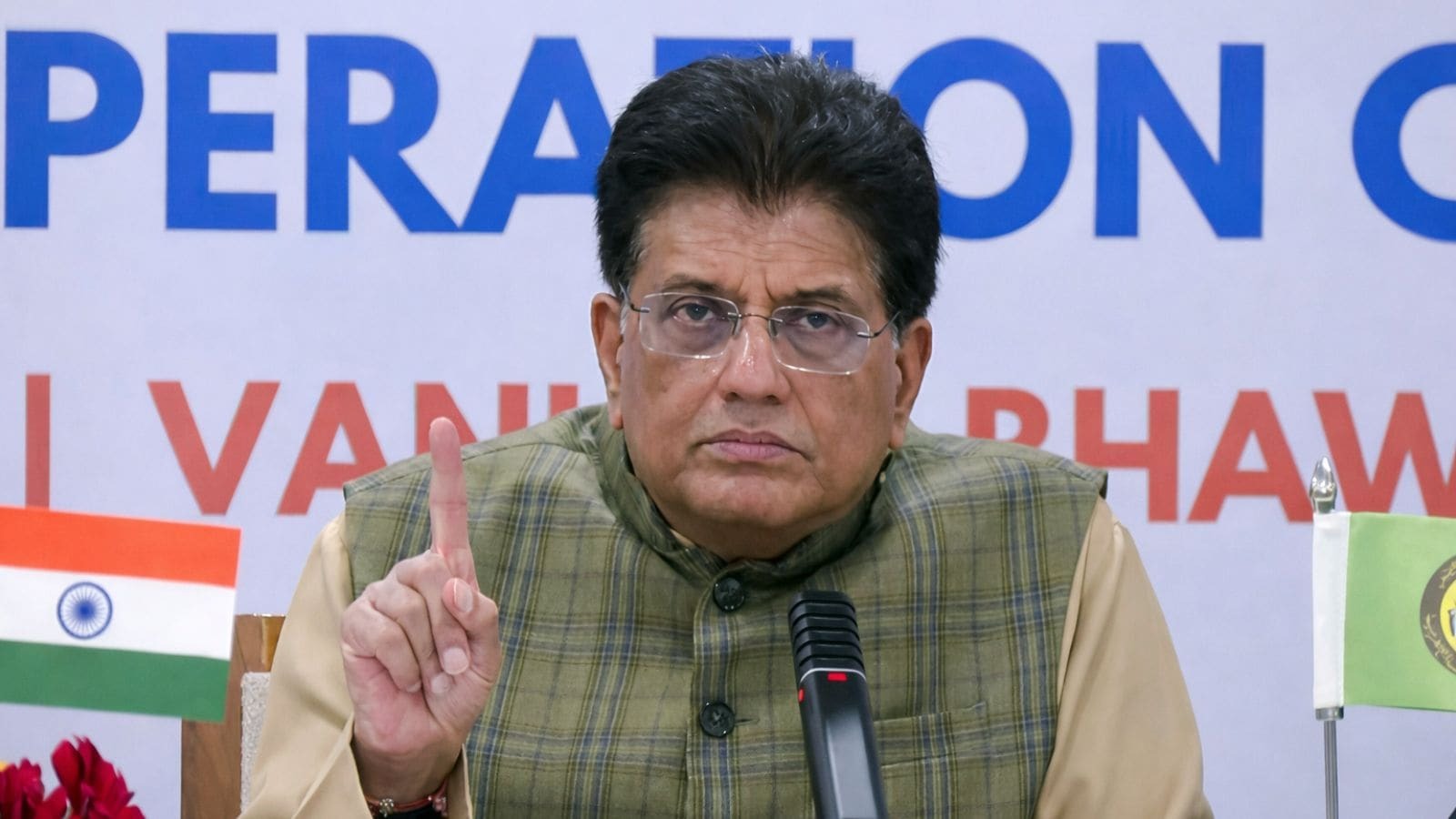
On February 8, 2026, Union Commerce Minister Piyush Goyal addressed the swirling speculation surrounding India’s commitment to purchase $500 billion worth of American products over the next five years. Speaking from New Delhi, Goyal clarified that this figure represents a “commercial intent” driven by India’s own developmental needs rather than a legally binding mandate.
Add businessleague.in as a Preferred Source


“We don’t have to; we intend to,” Goyal emphasized, noting that as India’s economy scales toward a $35 trillion market, a $100 billion annual import bill from the US is an “extremely conservative” estimate.
Also Read |Tamil Nadu Voter List Purge: 97 Lakh Names Deleted in SIR Phase 1
Intent vs. Obligation: Goyal’s Logistics Breakdown
The Minister was quick to dismiss claims of “total surrender” by the Opposition. He explained that India’s import strategy is rooted in current global procurement shifts.
-
Substitution Strategy: India currently imports roughly $300 billion annually in goods that the US is capable of supplying. By pivoting to the US where they are “preferred and competitive,” India aims to balance the trade deficit.
-
Continuity of Orders: The $500 billion figure includes existing multi-billion dollar contracts, such as the massive Boeing orders placed by Air India and IndiGo.
The $500 Billion Basket: What India Actually Needs
India’s shopping list is strategically aligned with its Digital India and Atmanirbhar Bharat missions. The primary drivers include:
-
High-Tech & AI: With India targeting 10 gigawatts of data center capacity, the demand for GPUs (particularly Nvidia chips) and ICT infrastructure is skyrocketing.
-
Aviation: Civil aviation orders for aircraft, engines, and spare parts are expected to exceed $100 billion in the five-year window.
-
Energy & Coking Coal: To fuel a steel industry growing from 140 to 300 million tons, India will require roughly $30-35 billion in coking coal annually, with the US being a key alternate to Indonesian and Russian sources.
Also Read |Tamil Nadu Voter List Purge: 97 Lakh Names Deleted in SIR Phase 1
Tariff Relief: A New Edge for Indian MSMEs
The most immediate benefit for India is the reduction of US reciprocal tariffs from a peak of 50% down to 18%.
-
Labor-Intensive Gains: Sectors like textiles, leather, footwear, and handicrafts are set for an immediate revival.
-
Competitive Edge: At 18%, Indian exports will face lower barriers than regional rivals like Vietnam (20%) and China (30-35%).
-
Zero-Duty Access: Nearly 50% of Indian exports—including gems, diamonds, and generic pharmaceuticals—will soon enjoy zero-duty entry under the interim framework.
The Agriculture Shield: Protecting the “Red Lines”
Addressing concerns of the farming community, Goyal reiterated that India’s “red lines” were non-negotiable during the talks.
“All dairy items, poultry, meat, rice, wheat, sugar, soya, corn, and all GM products are completely out of the trade deal,” Goyal stated.
While India will reduce duties on certain US “luxury” farm products like tree nuts, fresh fruits, and wine, strict safeguards remain for staples. For instance, US apples will face a minimum import price of ₹80 plus a ₹20 duty to protect domestic growers in Himachal Pradesh and Kashmir.
Also Read |Tamil Nadu Voter List Purge: 97 Lakh Names Deleted in SIR Phase 1
The Russian Oil and Visa Question
Two critical geopolitical points were clarified during the briefing:
-
Russian Oil: The 25% ad valorem duty linked to Russian oil purchases in 2025 was handled separately from the trade deal. Goyal noted that any “monitoring mechanism” on Russian oil remains under the purview of the Ministry of External Affairs.
-
H1B Visas: Interestingly, visas were not discussed in the final stages of the interim pact. Goyal remarked that the relevance of H1B visas has diminished post-Covid due to the rise of remote work and local talent development.
[ARTICLE SUMMARY TABLE]
| Sector | Indian Commitment / Action | US Reciprocal Action |
| Tech & AI | Increased sourcing of GPUs & ICT | Zero-duty access for Indian ICT |
| Aviation | $100B+ in aircraft & parts | Removal of Section 232 duties |
| Agriculture | Tariff cuts on nuts, wine, and soy oil | Zero-duty for Indian spices & tea |
| Pharma | Continued supply of generics | Promised zero-duty treatment |
| Sensitive | No concessions on Dairy/Poultry/GM | 18% general tariff on other goods |
Next Steps
The interim trade deal is expected to be formally signed by mid-March 2026, with US Trade Representative Jamieson Greer visiting New Delhi for the legal finalization. You should watch for the official Executive Order from the White House next week, which will provide the definitive list of products eligible for the 18% and zero-duty rates.
Also Read |Tamil Nadu Voter List Purge: 97 Lakh Names Deleted in SIR Phase 1
End…
Add businessleague.in as a Preferred Source

