


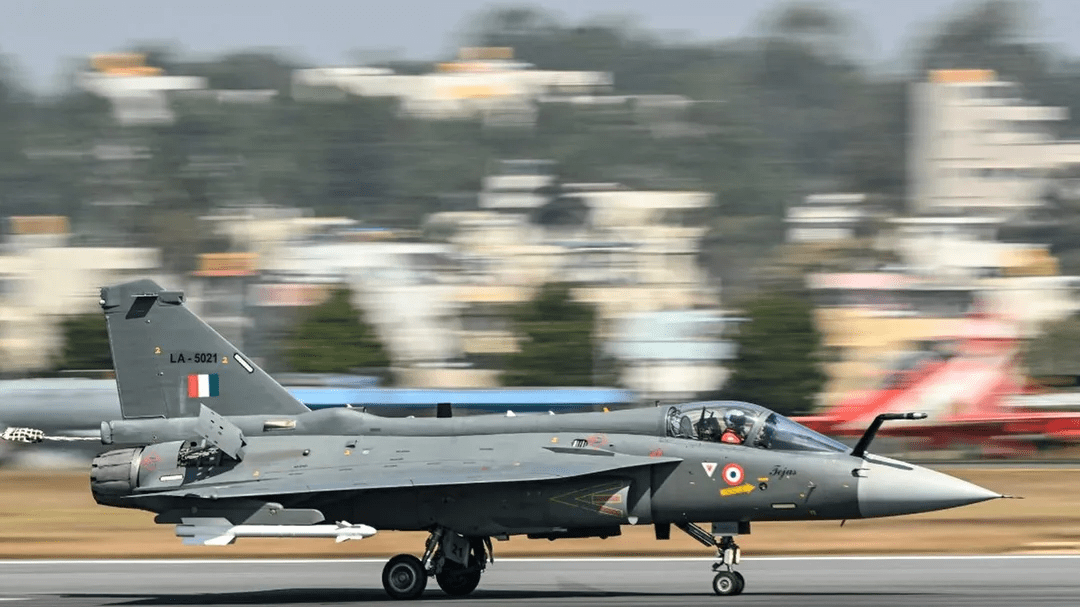
The Indian Air Force’s (IAF) indigenous LCA Tejas fleet is set to return to the skies on Monday, April 8, 2026, ending a two-month grounding sparked by a crash in early February. The manufacturer, Hindustan Aeronautics Limited (HAL), confirmed on Thursday that the technical glitch—identified as a software-related issue affecting the braking system—has been successfully resolved across the 34-aircraft fleet.
Add businessleague.in as a Preferred Source


This clearance comes at a critical time, as the IAF seeks to maintain high operational readiness amid the ongoing West Asia conflict and regional “war jitters.”
Also Read |Tamil Nadu Voter List Purge: 97 Lakh Names Deleted in SIR Phase 1
The Road to Recovery: Safety Protocols
The return-to-flight (RTF) process follows a rigorous investigative and engineering phase overseen by HAL Chairman and MD, D.K. Sunil.
-
The February Incident: The entire fleet was grounded after a Tejas Mk1 suffered a crash at a frontline airbase. While the pilot ejected safely, the aircraft sustained heavy damage due to a suspected brake failure during landing.
-
The Fix: Engineers traced the issue to a software anomaly. A revised patch has been uploaded to all active airframes to ensure the digital flight control system (DFCS) communicates correctly with the mechanical braking units.
-
One-Time Checks: Before the April 8 deadline, every jet will undergo a mandatory “one-time check”—a deep-dive preventive inspection to ensure 100% compliance with new, tightened safety benchmarks.
Tejas Mk-1A: Delivery Roadmap 2026
Despite the grounding of the Mk1, HAL is accelerating the delivery of the more advanced Mk-1A variant, which features superior radar and electronic warfare capabilities.
Also Read |Tamil Nadu Voter List Purge: 97 Lakh Names Deleted in SIR Phase 1
| Milestone | Target Timeline (2026) |
| Initial Mk-1A Batch | 6 Jets to be supplied “shortly” |
| Total Annual Delivery | 20+ Jets by December 2026 |
| Current Testing | Final integration of AESA Radar and missile-firing systems |
Investigative Insight: “India’s Pride” vs. The 2026 Reality
The grounding of the Tejas fleet was a major PR blow to the “Atmanirbhar Bharat” initiative, especially after PM Modi personally flew in the trainer variant last year. However, the quick two-month turnaround to find and fix a software-level glitch is actually a sign of technical maturity. In the past, such investigations into foreign-made aircraft (like the MiG-21 or Mirage) could take years due to “black box” proprietary data restrictions.
By resolving this internally, HAL has proven that India now owns the “Full Stack” of its fighter technology. This is vital because, with Defence Exports hitting ₹38,424 crore this year, any lingering doubt about the Tejas’s safety could have jeopardized multi-billion dollar deals with the Philippines and Argentina. The April 8 resumption isn’t just about pilot training; it’s about signaling to the global market that India’s flagship fighter is battle-ready and software-secure.
Also Read |Tamil Nadu Voter List Purge: 97 Lakh Names Deleted in SIR Phase 1
End….
Add businessleague.in as a Preferred Source

