


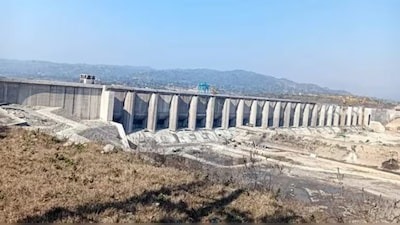
India will officially stop the flow of surplus Ravi River water into Pakistan by March 31, 2026. The completion of the Shahpur Kandi Dam project marks a decisive shift in New Delhi’s management of the Indus basin’s eastern rivers.
Add businessleague.in as a Preferred Source


Jammu and Kashmir Minister Javed Ahmed Rana confirmed Tuesday that the dam is nearing operational status. The move follows a year of heightened tensions and the formal suspension of the 1960 Indus Waters Treaty (IWT). By redirecting this “wasted” water, India aims to provide critical irrigation to drought-hit border districts.
Also Read |Tamil Nadu Voter List Purge: 97 Lakh Names Deleted in SIR Phase 1
Plugging the Ravi: The March 31 Deadline
The Shahpur Kandi project was first envisioned in 1979 but faced four decades of political delays. Therefore, its completion represents a major infrastructure victory for the current administration. The 55.5-meter-high dam will help irrigate over 32,000 hectares in Jammu and Kashmir and 5,000 hectares in Punjab.
Meanwhile, the project includes a 7.7-km hydel channel set to generate 206 MW of hydropower for Punjab. Total project costs reached ₹3,394 crore, with the Centre providing 20% funding. In fact, most of the 80 km of the Ravi canal had remained dry for years due to the lack of this specific barrage.
Operation Sindoor and the IWT Abeyance
India placed the Indus Waters Treaty “in abeyance” on April 23, 2025, following a major terror attack in Pahalgam. This strategic shift, dubbed Operation Sindoor, explicitly links water sharing to Pakistan’s state-sponsored terrorism. New Delhi has since stopped sharing hydrological data and flood warnings with Islamabad.
Next, the government has fast-tracked seven massive hydroelectric projects on the western rivers (Indus, Jhelum, and Chenab). These include the 1,856 MW Sawalkote project, now designated a “Project of National Importance.” Thus, India is asserting its sovereign rights over waters it previously left largely untapped for downstream use.
Also Read |Tamil Nadu Voter List Purge: 97 Lakh Names Deleted in SIR Phase 1
Agricultural Impact: Kathua vs. Pakistan
The diversion primarily benefits the Kandi areas of Kathua and Samba districts. Therefore, roughly 1,150 cusecs of water will be reclaimed for Indian farmers. Minister Rana stated that the priority is the domestic “drought-hit” belt, calling the previous flow to Pakistan “unnecessary wastage.”
In fact, Pakistan’s agriculture depends on the Indus system for 80% of its irrigation. Islamabad has approached the Court of Arbitration in The Hague, labeling India’s moves as the “weaponization of water.” Yet India rejected the tribunal’s supplemental award on February 2, 2026, declaring the body has no legal standing over sovereign Indian actions.
Reality Check
India has exclusive rights over the Ravi, Beas, and Sutlej even under the original 1960 treaty. Still, the lack of storage facilities meant surplus water flowed to Pakistan for 66 years. Therefore, completing Shahpur Kandi is legally compliant with the IWT’s core principles, regardless of its current “abeyance” status.
In fact, while Pakistan faces a harsh summer, its storage capacity barely covers 30 days of flow. Thus, the timing of the March 31 completion is strategically calculated. Still, internal disputes between Punjab and J&K over water-sharing ratios could still delay the full distribution of the diverted flow.
Also Read |Tamil Nadu Voter List Purge: 97 Lakh Names Deleted in SIR Phase 1
The Loopholes
The “abeyance” of the treaty is a unique legal state that isn’t explicitly defined in the original 1960 document. In fact, Article XII(4) states the treaty can only be terminated through a mutual written agreement. Therefore, India’s unilateral suspension sits in a gray area of international law.
Still, the government argues that “blood and water cannot flow together,” citing the doctrine of rebus sic stantibus (fundamental change of circumstances). Therefore, New Delhi considers itself exempt from data-sharing duties. Yet the World Bank, as the treaty’s guarantor, has remained largely silent, providing India with a diplomatic window to finish its dams.
What This Means for You
If you are a farmer in Kathua or Samba, prepare for the first full irrigation cycle starting this April. First, verify the canal network connections to your fields; much of the existing infrastructure has been idle for decades. Then, expect a significant increase in crop yields for the upcoming Kharif season.
Also Read |Tamil Nadu Voter List Purge: 97 Lakh Names Deleted in SIR Phase 1
Finally, realize that regional tensions will likely rise as the March 31 deadline approaches. Before traveling near the border, monitor local safety advisories. You should also expect higher electricity availability in Punjab by late 2026 as the Shahpur Kandi hydel units begin synchronized testing.
What’s Next
The Shahpur Kandi barrage will begin its first water diversion trials in mid-March. Then, the Prime Minister is expected to visit the dam site for a formal dedication on March 31, 2026. Finally, the Sawalkote Hydroelectric Project on the Chenab will open its main tender process by April 15.
Also Read |Tamil Nadu Voter List Purge: 97 Lakh Names Deleted in SIR Phase 1
End…
Add businessleague.in as a Preferred Source

