
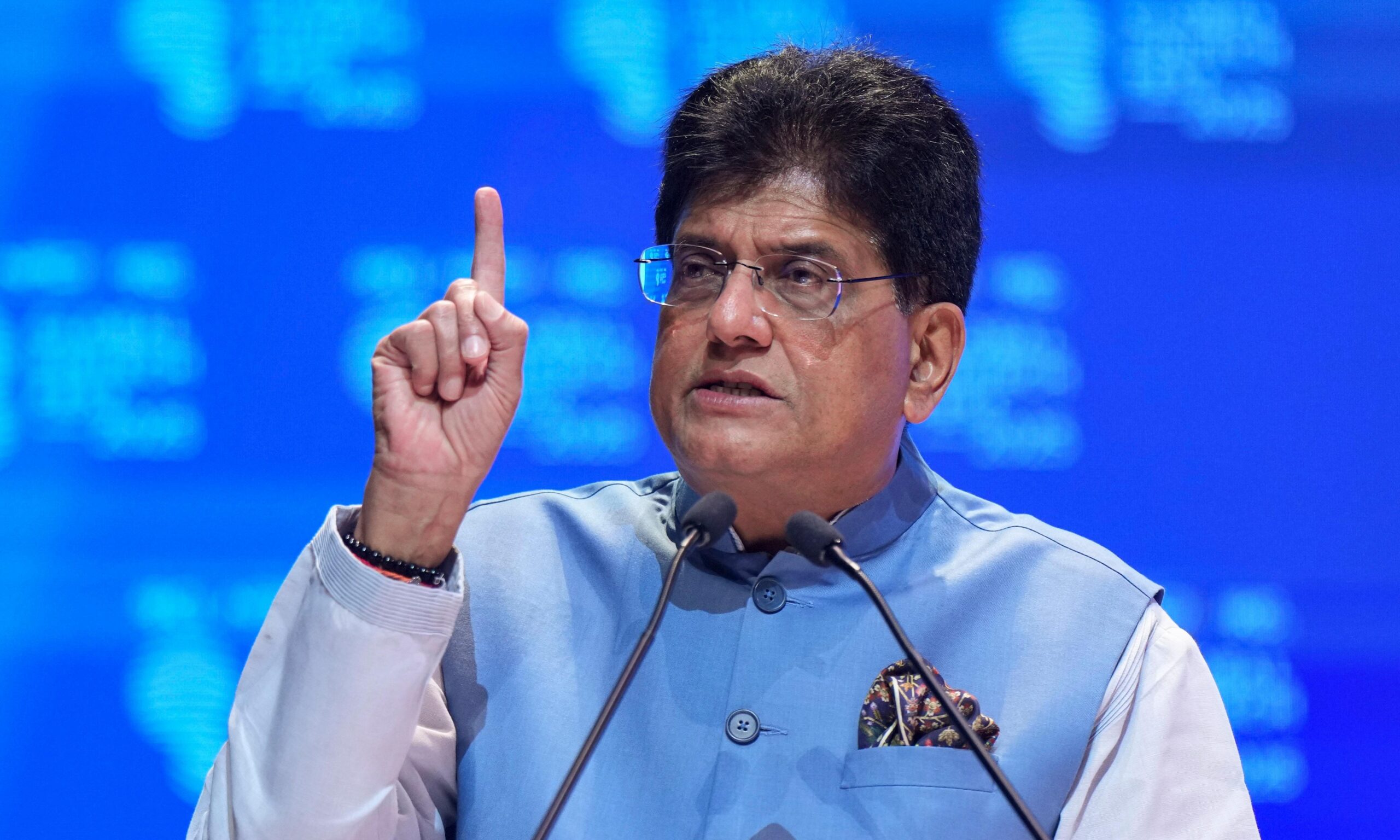
Union Minister of Commerce and Industry Piyush Goyal declared Thursday that India is negotiating its future from a “position of strength.” Speaking in Mumbai, Goyal highlighted that the nine Free Trade Agreements (FTAs) inked since 2022 were specifically designed to secure the interests of farmers, fisherfolk, and MSMEs.
Add businessleague.in as a Preferred Source


The Minister projected that India will become the world’s third-largest economy by 2027-28. He further estimated that the nation would add approximately $26 trillion to its economy by the centenary of independence in 2047. Goyal emphasized that these trade deals are long-term investments rather than short-term concessions.
Also Read |Tamil Nadu Voter List Purge: 97 Lakh Names Deleted in SIR Phase 1
The Positioning: Strength over Meekness
Goyal asserted that the scale of India’s current growth is “unparalleled in history.” He argued that the era of India appearing as a “meek” or “apologetic” country on the global stage is over. The recent FTAs, including those with the UAE, Australia, and EFTA, were concluded by prioritizing national sensitivities.
Meanwhile, the Minister noted that economic diplomacy is now rooted in expanding trade and securing global opportunities for Indian youth. “Gone are the days when one could live in economic isolation,” he stated. In fact, the recent India-US trade deal (February 2026) significantly lowered tariffs, providing a much-needed outlet for Indian capital.
Safeguarding the “Red Lines”: Dairy and MSMEs
A recurring theme in the Minister’s address was the protection of sensitive sectors. Goyal highlighted that the government refused to open dairy farming to any country, including traditional dairy exporters like Australia and New Zealand. This stance was maintained despite these nations usually demanding dairy access as a prerequisite for any FTA.
Next, the focus has shifted toward securing market access for labor-intensive sectors. These include:
-
Textiles and Footwear: Lowering entry barriers in European and American markets.
-
Pharmaceuticals: Expanding export footprints through simplified regulatory recognitions.
-
Marine Products: Ensuring that the interests of the 14-million-strong fishing community are preserved.
The $26 Trillion Vision by 2047
Goyal credited PM Narendra Modi with shifting the focus toward “inclusivity and quality of life” as the foundation for economic expansion. He cited the rapid growth of physical and digital infrastructure—specifically the 500 GW transmission network—as the backbone for future trade.
Furthermore, with the recent FTAs with the US and the European Union, Goyal expects a “flood of capital” to enter India. He argued that India currently offers the “finest returns” globally. Therefore, the long-term goal of adding $26 trillion by 2047 is not just a target but a logical conclusion of current trade momentum.
Also Read |Tamil Nadu Voter List Purge: 97 Lakh Names Deleted in SIR Phase 1
Reality Check
Minister Goyal claims these 9 FTAs were signed from a position of strength. Still, several sectors, particularly the dairy industry, remain extremely wary of any “framework” changes in the long run. Therefore, the “red lines” today may face pressure in 2030 as partner nations demand reciprocity for Indian textile access. In fact, while the India-US deal lowered tariffs to 18%, the Opposition continues to question if this liberalization will eventually hurt the very farmers the Minister claims to protect.
The Loopholes
The Minister noted that dairy was not opened to Australia or New Zealand. In fact, while “raw milk” imports are restricted, loopholes often exist in “processed” dairy components and high-end cheeses. Therefore, MSMEs in the processing sector must remain vigilant about indirect competition. Still, the government’s refusal to budge on the dairy sector during the Australia FTA (ECTA) remains a significant political and economic victory for the domestic cooperative movement.
Also Read |Tamil Nadu Voter List Purge: 97 Lakh Names Deleted in SIR Phase 1
What This Means for You
If you are a farmer or an MSME owner in the textile or leather sectors, the next 24 months offer an unprecedented export window. First, verify if your products qualify for the 18% tariff reduction under the recent India-US trade deal. Then, look into the “Export Hub” schemes being promoted by the Commerce Ministry to help small players navigate international logistics.
Finally, realize that the goal of becoming the 3rd largest economy by 2028 will likely trigger significant domestic infrastructure spending. You should monitor the expansion of the 500 GW transmission network if you are in the energy or manufacturing space. Before the next fiscal year, expect a new set of “Quality Control Orders” (QCOs) designed to make Indian products more competitive in the EU and US markets.
What’s Next
The Ministry of Commerce is expected to finalize the next round of “deep-dive” negotiations with the UK by mid-2026. Then, a new “MSME Export Policy” will likely be unveiled to streamline the benefits of the 9 FTAs. Finally, the first major review of the India-US trade deal’s impact on the agricultural sector is scheduled for early 2027.
Also Read |Tamil Nadu Voter List Purge: 97 Lakh Names Deleted in SIR Phase 1
End…
Add businessleague.in as a Preferred Source
🙏 Support Independent Journalism
We keep news free for you.
Most readers support with ₹500 ❤️
or scan QR below

Voluntary contribution. No tax benefits.
DISCLAIMER
We have taken all measures to ensure that the information provided in this article and on our social media platform is credible, verified and sourced from other Big media Houses. For any feedback or complaint, reach out to us at businessleaguein@gmail.com